

creative love

Due to an unexpected turn of events this week (a stolen wallet, fraudulent charges to my bank card and all that goes along with getting your life back to normal afterward — a topic about which I may write in more detail at a later time), I'm still not quite over the finish line where the audiobook release of The Best Advice So Far is concerned.
In the meantime, I thought I'd share one more audio chapter — Chapter 14: “Creative Love.”
This chapter has remained one of the most popular and most talked about chapters of the book. What's more, the chapter combines memories from 4th-of-July celebrations both recent and long past. So in honor of Independence Day, Tuesday here in the U.S., I thought sharing this chapter would be apropros.
Click the link below to listen to the official audiobook recording of Chapter 14: “Creative Love” (the full chapter text is below, if you'd like to follow along):

CHAPTER 14
CREATIVE LOVE
A year has passed since I got caught in that 4th-of-July traffic jam I told you about in the chapter on choosing positivity. Last night, I joined the best people for food and fireworks by the ocean. Unlike many towns, this one has taken to allowing private citizens to light their own fireworks along the shoreline. Not sparklers and bottle rockets, mind you. Real, honest-to-goodness fireworks. And lots of them.
Of course, this is all off the books. Fire and police officials “happen” to be very busy in remote parts of town at those hours, it seems — ::wink wink:: — but let's just keep that between ourselves, shall we?
As our little clan made our way along the sidewalks, the town was out in force. Patriotic music played strong and clear as we passed one yard, then seemed to garble like the tuning of a short-wave radio as we walked, only to gradually form itself into another solid tune as we approached the next yard — all accompanied by much boisterous and bad singing. Dogs strained at leashes, barking wildly at the cacophony. Children clustered together on quilts and blankets, bedecked with glowing bracelets and necklaces and halos, all wide-eyed and slack-jawed as they beheld the wonders in the sky.
The sea wall was packed, layers deep. No one seemed to mind. But I navigated my way through the crowd and down the concrete steps, then jumped from the wall to enjoy the spectacle from the rocky beach below. The nearest firework bundles and boxes were a mere twenty feet away from where I sat. Should be exciting.
The colors and assortment were dazzling, all fired quite low and seemingly right overhead. But what struck me most was the magnitude of sound. Whizzing. Screeching. Whirring. BOOMing. It was the loudest I could recall.
Ever.
At one point, it became overpowering. The sound — not the light — was actually hurting my eyes. So I closed them for a moment, placing my hands over them and pressing firmly with my fingertips. That's when the flashback hit.
Ricky.
It was the summer I had graduated from high school. I'd gotten a job at a school for the blind, and I had three “boys” assigned to my care, all of them in for a short-term summer program. In truth, they were each older than I was.
Ricky was 18. Aside from being blind, Ricky had pronounced Asperger's Syndrome. This was also accompanied by a form of echolalia. That is, Ricky's tendency was to copy or rephrase what other people said, rather than forming responses with any real personal meaning. So, if one asked Ricky, “Are you having a good day?” he might reply “I'm having a good day” — whether he was having a particularly good day or not.
Ricky was the best. Though he was a year older than I was, he had the affect and voice of a sweet-tempered six-year-old. I was fascinated, but even more determined to have actual communication with him. I was 17 and had no real training. What did I know. But I thought it odd that staff just fell into Ricky's patterns, asking predictable and repetitive questions to which they got his predictable and repetitive responses. One day early on, I tried something.
“Hi, Ricky,” I said.
Ricky smiled, weaving his head back and forth, which I already understood meant that he was excited and happy. “Hi. Hi, Ricky. Hi,” he replied.
“Did you have a good day today?” I asked.
“I had a good day today,” Ricky said.
“And what did you like about today?” I continued.
Ricky fell silent. He stopped swaying as if he were listening for something far off. Then he continued his dance, without answering me.
I tried again. “What did you like about today, Ricky?”
He paused again for a moment, then resumed his rhythmical bobbing. “It's nice,” he said.
I welled up (much as I'm doing even now as I recall it). Ricky had given a real answer!
I continued asking only questions which Ricky could not repeat or rephrase with ease. In what seemed a very short time, Ricky and I were having meaningful exchanges regularly.
I remember the day — or rather the night — that Ricky spoke first to me, without my having asked him anything. I had just tucked him into bed and he began to cry. “I'm sad,” he said. This was very unusual for someone like Ricky, to report on how he felt, however obvious.
“Why are you sad, Ricky?” I asked.
“Mom,” he said.
“You miss your mom?” I asked, again finding this peculiar behavior, even without any real training.
“I miss my mom,” he replied, giving in to his comfort zone of repeating. But that was all right. He'd already told me as much.
Ricky sobbed for a long time that night without any more talk. I stayed with him, lightly raking his hair with my fingertips or squeezing down his arm, which he enjoyed. After more than an hour, he finally fell asleep.
This same scenario played out for the next three nights. Ricky would cry when I put him to bed, and I would stay with him and get him to sleep. After a few days of contemplation at his bedside, I had concocted a plan. There was no way to be sure whether or not it would work, except to just try it and see what happened.
The next day was my day off. I picked up a painter's cap for $5.00. I chose it because it was soft and durable, and the lid was flimsy instead of hard. The following day, I tucked the hat inside my work bag. When bedtime came, sure enough, Ricky began to be homesick. I hated to think about the night before, because I knew the other staff member would not have stayed with him or comforted him. As Ricky began to cry, I took out the hat. I placed it into his hands and helped him feel it. “What do you think this is, Ricky?”
“A shirt,” he guessed.
“Nope. It's not a shirt. Good guess. Try again,” I urged.
“Try again,” he agreed. A few moments later, he said, “Underwear,” then scrunched his face up and giggled like he'd told a naughty joke.
Weeks ago, when Ricky had first arrived, I'd helped him unpack. He had exactly two pairs of yellowed underwear in which the elastic waistbands were stretched and torn. There were two undershirts and one pair of socks, all in similar repair, along with a couple of T-shirts, a pair of jeans and one pair of shorts. This was to last the whole summer. The following day, I had immediately gone shopping and later presented Ricky with a small but new wardrobe — one item at a time. And so it seemed he did remember the day I had given him the underwear, as he guessed at what lay in his hands now. The memory of Ricky's reddened face, giggling even as the tears of homesickness streamed down, is still very clear in my mind.
I laughed, too, and replied as if he'd really gotten me with his joke. “No, Ricky, it's not underwear, silly. It's a hat.”
“It's a hat,” he said, as if he'd thought of it himself. He felt around the opening and the rim again, trying to make sense of the new revelation.
“It's not just any hat, though,” I said mysteriously. “It's a magic hat.”
He didn't reply this time, just listened. I had his attention.
“Here's how it works. You say out loud all of the things you miss and love about home, and the hat remembers them. Then, you put on the hat, and it helps you think good things about what you miss, so you won't be sad while you fall asleep. So, here we go. Let's hold the hat together in our hands and think of as many things as we can think of that you love about home. What's first?”
“Mom,” Ricky said, sniffling.
“Good one! And what else do you love about home?” I prompted.
He scrunched his eyes, which were always closed, as if considering. “Cookies.”
“Cookies? Nice! And what else?”
“Books.” (I hadn't realized before then that, of course, he might like a bedtime story. But I didn't interrupt.) Ricky had already stopped crying as he thought. Before long, his answers became mumbles that meant he was drifting off . I took the hat from his hands.
“OK, now let's put the hat on you, so you can think about all those things you love about home,” I said as I pulled the hat over his mop of brown hair. He reached up and touched it, then pulled the covers up and fell asleep. “Good night, Ricky,” I said.
The plan had worked. And it continued to work every night thereafter at bedtime.
The 4th of July fell on a Saturday that year, and most parents had come on Friday to get their children for the weekend. Ricky's parents lived in New York, and so had not come. I offered to take Ricky to fireworks that night, even though I was not on shift. This was met with much debate. Bringing a blind student with multiple needs to an event like fireworks? Too upsetting. And you're not even working. But no one could argue that Ricky trusted me and was calmer when I was on. And I had clearance to drive the vans. My taking Ricky for the night would also mean that other staff would not have to stay on duty for one student.
And so, we went.
Now, I honestly can't remember how the next turn of events came about. But my sister Shannan wound up coming along. She was sixteen at the time, and had absolutely no experience with special needs. Still, she came. I wondered how she would be with Ricky.
Ricky grew very anxious as the crowds thickened approaching the main event. Shannan and I told him that fireworks would sound very loud and scary, but that it was the fun kind of scary. “It's fun,” he said, but he didn't seem too sure. Patriotic music played somewhere close by. My sister, without hesitation, asked Ricky if he would like to dance. Ricky's whole life was a dance, in a way — rocking and bobbing and doing the two-step. And so he accepted her offer. She helped him up and fell right into his little two-step, as if it were the cool kids' dance. “You're a really good dancer, Ricky,” she said.” He laughed his giddy laugh. “I'm a good dancer!” he shouted, elated to be dancing with a real live girl.
Soon, the first “test” rockets fired, and Ricky was clearly nervous. We sat down on the grass, my sister on one side, and I on the other, pressing in tight on either side so that Ricky would feel safe. “This is going to be a lot of fun!” I assured him. “All of the sounds will be different, because the fireworks look different.”
For Ricky, there would be no bursts of color. No designs in the air. No light — only sound. Ricky tilted his face upward in expectancy, as he waited for whatever would happen next, somehow understanding that the noise had come from above him.
Then my sister said something which I'd forgotten until the memory resurfaced last night: “I'll draw pictures on your back of what it looks like.”
It was brilliant, really. And moving.
The first legitimate explosions rained overhead. Ricky gasped, but he didn't seem anxious now. I squeezed his hand and said, “Wow! This is scary! Sometimes, it's fun to be scared!” Ricky smiled, with red light shining on his upturned face. Shannan got up and knelt behind Ricky, then wiggled her fingertips over his back in an outward motion approximating what was happening in the sky. The next one screeched out five separate rockets that spiraled away at the end. Ricky squeezed my hand tighter. My sister drew arcs with curly-Qs up Ricky's back, one at a time. And so it continued.
I really believe that Ricky was having all the fun of going to a scary movie with good friends. He began to laugh out loud, or crouch smaller at the bigger booms, giggling. All the while, I squeezed his hand as my sister drew forms.
THE BEST ADVICE SO FAR: Tenacious love expressed with creativity can work wonders.
Another shattering *BOOM* brought me back to the present, where I sat there with my fingertips still pressed over my eyes. A few tears escaped as I remembered Ricky and the events of that night.
I wondered where he was, and what he might be doing today.
I wondered if he still had the magic hat.
I wondered if he remembered me, or that night when he'd danced with a girl who smelled nice.
I wondered if he might be at fireworks somewhere even tonight, smiling, squeezing his hand tighter and feeling imaginary fingertips drawing pictures across his back.
What I did not need to wonder about — what I was certain of — was that time, creative energy and love had been well spent all those years ago.



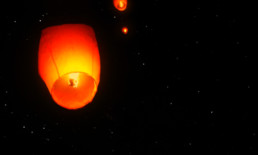
fire in the sky

I’ve had a document open since the 4th of July with title and picture in place, ready for me to write this post.
Each day since, I’ve sat down in front of a blank page. I’ve stared. I’ve thought. I’ve thought about what I’m thinking. I’ve done the self-talk to convince myself: This is going to be the day.
It’s been over two weeks of this routine.
Usually, a blank page excites me. Since I was a child, a blank page has always represented endless possibilities. Lately, a blank page has felt like … just a blank page.
Today is the first time words have come out.
I’m hopeful.
While it’s true that my head is still a bit scrambled due to the accident in April, I think there’s more to it where this particular post has been concerned. I had what I can only call “an experience” over the holiday weekend. I don’t often use the word profound, but this was. I felt something. I made connections I hadn’t before. Parts of what lay within the scope of my physical senses came into crystal clear focus while others seemed to fade to nothing. Invisible. Inaudible.
It came in pictures. It came in inklings and suspicions that burgeoned into something close to ideas. It came in emotions.
The problem is that it did not come with words.

It has felt like it needs to be written. I tried getting around it and on to other topics, chalking it up as perhaps something that should remain with me alone. But it has stayed put, unyielding, like an avalanche that simply has to be cleared from the road if there’s to be any hope of moving forward. And yet in the last 24 hours, a realization struck me: I’ve actually been afraid to put it to words, for fear that it will be lost in so doing, like trying to pluck snowflakes from the air with warm fingers.
My brain and eyes hurt as I consider trying to do what seems impossible in the moment. What if the words I choose wind up stripping the heart from it all, rendering something beatific as banal?
Don’t get me wrong. It was not an epiphany of the religious sort (at least not as far as I know). The sky did not weep blood. There were no ladders descending from the heavenlies. But it felt pivotal nonetheless.
I think what finally has me writing is that I wrestled the angel and won. I’ve let go of the notion that I need to make it all make sense, to open any eyes other than my own. So if you read on and find yourself ho-ing and humming, that’s OK. And if even one other soul out there sees a glimpse of what I saw that night, I’ll consider it purely serendipitous.
*****
To be honest, the 4th of July is not among my favorite holidays. Yet somehow, it’s wound up being the backdrop for many key moments across a lifetime, including one of my favorite chapters in my book — a chapter entitled “Creative Love” (Chapter 14), which was adapted from one of my early posts.
I should point out that, for the past twenty-some-odd years, my 4th of July festivities have actually taken place the day before, on the 3rd. Friends host an evening party down by the ocean. And as dusk gives way to darkness, from points up and down the coastline, you begin to hear the first isolated eruptions.
*bang*
*sizzle*
*whirrrr*
*screeeech*
*pop-pop-pop*
Young and old alike don bug spray and glow-things, cover-ups and star-spangled headbands. And, like psychedelic lemmings, they make their way toward the source of those sounds.
They line the sidewalk above the sea wall, packed in shoulder to shoulder. But I squeeze through them, over the guard rail, down the slope to the wall itself, rocks skittering under my sandals.
I do not stop there. I sit on the wall, feet dangling, and hop to the gravel along its lower edge. Secretly, I feel a certain sense of accomplishment and pride that I can still make the leap “at my age.” Then I make my way down — across the tops of the precarious larger stones, over the plain of pebbles and onto the dark sand. There, I settle myself on the same protruding rock that has been my perch these many years.
Any time I’ve tried to explain the ambient soundscape, I wind up coming back to the word “cacophony.” Every house along the coast is blaring different music. Orchestral patriotic numbers try valiantly to surface, pulled down by the quagmire of competing drum beats and gratuitous 80s guitar riffs. Dogs bark. Children holler to be heard by parents standing right beside them. Some cry as adults try to explain with exaggerated smiles that all of this noise is quite natural and “fun.” Laughter comes in rippling waves — rowdy, raucous, strident, bellowing.
Then comes the first squint-inducing :: BOOOM! :: as the major fireworks begin in earnest.
The nearest pyrotechnics are being launched not more than twenty feet from where I sit. I do not look out to see them. I look up — straight up, my neck cranked backward at a 90° angle. Every so often, one of the projectiles detonates too low, and I am showered in ash and glowing embers that fizzle out only after landing on moist skin or wet sand.
It’s quite a spectacle. I don’t just have front-row seats; I am center stage.
As if in unison, the surrounding throng cheers and squeals and shouts in direct proportion to the size, brightness and volume of each explosion.
This is the way of things, year after year.
Only this year — something changed.
The main attraction was playing itself out overhead. The growing cloud of acrid smoke wafted my way, stinging my eyes and blurring my vision. The sulfur bit at my nose. And each shock wave set the fine bones around my sinuses to reverberating. I took a reprieve from watching, slowly righting my stiff neck and pressing cool fingers over my eyes.
This in itself is not an unfamiliar part of the event. But when I opened my eyes again, my attention was immediately drawn to a soft orange glow in the distant sky, its reflection glimmering on the surface of the water.
A floating lantern.
Though it was much further away than the immediate spectacle, it consumed my focus. I tracked its almost imperceptible movement across the horizon. The noise of the fireworks and the crowd grew muffled somehow, as if I were covering my ears.
All the while, as I continued to follow the steady course of that far-off light, the quieter sounds around me became all the more clear.
The gentle shooshhh along the water’s edge as the surf swelled and receded, followed by the gabble of tiny pebbles being pulled over one another and back into the sea.
The rasping whisper of dried seaweed stirred by the faint breeze.
The sound of my own breath as I exhaled.
Nearby and to my right, two children — a boy and a girl, perhaps 10 or 11 — had placed their own sky lantern gingerly on the sand. After a few failed attempts to ignite the wax, the flame took hold, growing in intensity, setting the expanding white paper above it awash with amber light.
It swelled and began to levitate from the sand, tentative and unsteady. The children worked together to cradle the base and sides as it rose — slowly, slowly — until, finally, with one last gentle push, it was up, up, up and out across the water. I knew that the children were holding their breath. I knew that I was. I can’t explain it, but it felt like a physical vessel of hope.
I watched it go, making its journey ever higher, ever further, until it was no more than a pinpoint, indistinguishable from the backdrop of stars.
As serene as it all was, however, there was something more happening on a deeper level. There was meaning.
Katy Perry’s #1 hit “Firework” was an anthem for underdogs everywhere. In the chorus, she belts:
Baby, you're a firework
Come on, let your colors burst
Make 'em go, "Aah, aah, aah"
You're gonna leave 'em all in awe, awe, awe
Again, I don’t quite know how I’ll manage to condense into words and sentences the thoughts that crystallized there on the beach that night. But I’ll start by saying that, while I have been known to give Katy a run for her money, singing harmonies with her at the top of my lungs while driving, I am not her intended audience.
I’m not the wallflower at the dance.
I never “feel like a plastic bag / Drifting through the wind,” aimless and lacking a sense of purpose.
I’m not one to stand in the shadows, wishing for some assurance as I try to muster enough courage to take a chance.
And I’m not in any way belittling those who do find themselves identifying with these scenarios. I’m simply saying — that’s not me.
I am the firework.
I have always been.
In the bridge section of “Firework,” Katy sings:
Boom! Boom! Boom!
Even brighter than the moon, moon, moon
It's always been inside of you, you, you
And now it's time to let it through-ough-ough
But from as early as I can remember, Boom-Boom-Boom! moments have never had any trouble getting “through-ough-ough.”
I mentioned this in a previous post (which was also revelatory), but my mother will tell you that when I was very small, I used to make entrances by bounding through doorways, announcing my arrival with “Tah-Dah!” as if I were really something special.
*BOOM!*
At the age of six, I read my first real novel and memorized the scientific classifications of insects and fish, as well as the list of the longest words in the English language.
*BOOM!*
People would toss me a Rubik’s Cube and shake their head as I solved it in mere seconds. When it came time for art contests, I didn’t just draw a picture; I created intricate images using one continuously weaving line that never left the page and never crossed itself.
*BOOM!*
I was a 4.0 student and the top student at every level of my education.
*BOOM!*
I’ve sung before audiences of hundreds — even more than a thousand. I’ve hit the high note. I’ve moved the audience to tears. I’ve received the applause, the standing ovations.
*BOOM!*
I’ve been on the ins with the famous and the infamous. When I write letters to moguls, mavens and movie stars — they write back.
*BOOM!*
People who’ve known me have been either avid proponents or vehement opponents, but everyone chooses a side. There is no middle ground. For better or worse, I make an impression. People remember me.
*BOOM!*
I’ve made bricks with no straw. I’ve righted the flag in the heat of battle. I’ve been the voice of the masses against corruption and injustice. I’ve been a father to the fatherless. I’ve sung the blazing anthems to encourage the downtrodden, and I've taken their hand to pull them up again. I’ve swooped in to save the day at the eleventh hour more times than I can count.
*BOOM! BOOM! BOOM!*
Mind you, I don’t try to be noticed. It just ... happens. It’s just part of who I am. It was in the little boy who jumped through doorways and it’s in the man-me. I’m a chance taker. I believe we’re all just real people — rich or poor, famous or obscure — and so I tend to approach everyone the same, neither fearful nor fawning. And for some reason, that stands out in the world.
I have no regrets. But that night on the beach, as the fireworks thundered and raged overhead, I envied the paper lanterns.
Quiet. Constant. A glow on the horizon. A symbol of hope.
I wanted to be like that.
I want to be like that.
I’d rather be known for what I am doing than for only what I have done, to be the steady beacon rather than the sudden *BOOM!*

I’m not trading my leaps for tiptoes. I’m not saying goodbye to doing big things. I still have a fire burning inside of me. I think, perhaps, it’s just becoming a fire of a different sort.