
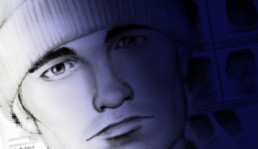
sketchy
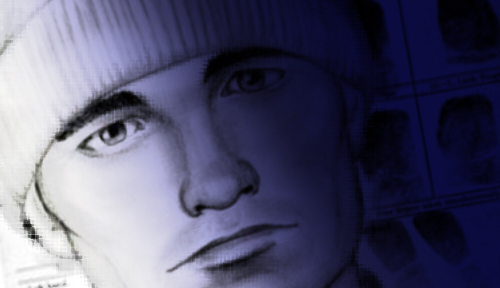
Last night, on my way out the door to grab a late snack with my young friend Ben, I noticed that trash had accumulated in the kitchen. Two full bags sat beside the garbage can, along with a couple of empty cardboard boxes. Time for a dumpster run. So, using every one of my fingers, I held and hung and balanced the trash along with my phone, keys and backpack, maneuvering sideways through doorways down the three flights of stairs and out to the lot.
It stunk outside. It often does here. Unfortunately, what they don't tell you when you move in is that there is a sewage treatment plant just behind our community, which does night work. On warm and humid summer nights, it can be powerful. But I've learned to live with it.
The lot was very dark, especially in the far back corner of it, where the woods press in around the dumpster. As I made the trek there to dispose of the trash, I noticed a character in the shadows. He was not dumping anything. He was just sitting there beside the wooden picket fence that surrounds the rubbish bin, elbows on knees, looking down. He wore a hat, pulled low. I couldn't see his face as he looked down at what appeared to be some sort of large, shallow container. It looked like something from a chemistry set. I saw a small ember of light begin to glow in his hand. Was he … doing crack? Setting up a makeshift meth lab right here in my parking lot? As I got closer, he cast a Godfather glance up at me without raising his head.
In yesterday's post, entitled "what's in a name," I ended with this:
Using people’s names is just one more way to stay outward focused, instead of being all about me. Whether it is your neighbors, co-workers, gas attendants or people on the train, each has a real life. An important life. Struggles. Goals. Dreams. Families. At core, I believe we each want to connect. To matter.
We each have a name. Look for opportunities to really see people. Interact. Be vulnerable. Be genuine. Before long, what may have once seemed daunting will become a natural, full and enjoyable way of life.
And this really is a way of life for me. That doesn't mean that I stop and talk to every person along my path. But, having just written yesterday's blog post, the idea was fresh in my mind that even sketchy guys who sit out by dumpsters in the middle of the night doing God-knows-what … are real people.
I also encourage readers to be vulnerable and to take risks. And while I'm comfortable with people from all walks of life, the unknown factors presented here made this about as big of a social risk as I might face.
So I did.

As I began to hoist the trash in my hands, ready to toss it in through the sliding door of the dumpster, I smiled and used the sewage smell to my advantage. "Hey, what's up! Did you come out to the dumpster to escape the smell of the rest of the place?" I threw the garbage, which landed with clunks and rattles.
The stranger looked up at me, smiling. "Ha-ha, yeah! What is that smell anyway?" He was a young guy. I could see now that the glowing ember of light was coming from a standard cigarette. He sat in a swivel chair, the kind someone might have in an office. I still didn't know what the plastic tubs at his feet were for.
"It's the sewage treatment plant. It's right behind the woods there," I pointed, "and they tend to do their dirty work at night."
"OK. I thought it was a sewage leak. I didn't know if I should call maintenance or the town," he replied.
"Oh, so you must live here," I said. "I live in Building 8 over there. My name's Erik."
He smiled even more broadly. "Hey, I'm also Eric! I just moved into Building 1." He gestured to his right with the cigarette hand.
"Well, your name should be easy to remember then!" I said. "Do you spell it with a 'C' or a 'K'?"
"Just a 'C', nothing fancy" he said, almost apologetically.
"Mine's with a 'K'," I replied, feeling guilty.
"Oh, man. You're lucky. The Nordic version. I always wished I'd gotten that one." This guy wasn't stupid.
"So … I have to ask," I half-laughed with a raised eyebrow. "Why are you sitting in a swivel chair, smoking out by a dumpster in the middle of the night?"
"Sketchy, right?" He laughed. "I came out here to empty the cat boxes" [mystery of the plastic containers solved!] "and saw this swivel chair that someone threw out. I was testing it to see if it was broken, because I need a chair for my desk. Seems to be in pretty good condition. Not dirty. I always loved spinning around in these when I was a kid. So, I just decided to have a cigarette and spin around in it for a while." He laughed again sheepishly. "I stopped when I saw you coming."
OK, so he wasn't sketchy. He wasn't the Godfather. He wasn't a druggie. He was just a real guy like me. A nice guy.
His cigarette was finished. He plopped the cat boxes on top of the chair and began to drag it toward his building. I walked with him a little ways. "Well, I'm sure I'll see you around then. Nice to meet you, Eric." I extended my hand.
He shook it firmly. "Nice to meet you, as well."
As well!
My eyes got a bit wider in surprise. Hands still locked, I replied, "We seem to have a lot in common, Eric! You say 'as well'! It's not often that I find someone else who prefers 'as well' over the more common 'too'!"
He replied modestly, "I read a lot."
"I do, as well!" I returned. We both laughed.
"Then we have a lot in common, indeed," he replied.
"'Indeed'? You say 'indeed,' as well?" I was almost giddy. "OK, OK. We need to stop now or we'll be standing here all night…"
We laughed one more time, said our goodbyes, and headed for our separate destinations.
Now, you may be thinking, "Well, you didn't know how it would turn out. He could have been a drug addict!" That's true. He could have. That's why it's called a "risk." I suppose it's possible that he could have leaped up erratically and assaulted me with his red hot crack spoon. It's unlikely, but possible. But what I know to be true is that he would still have been a valuable person, with a name and a story. I was willing to take a chance on that basis.
As I walked toward my car, hearing the scrape of the swivel chair wheels on the sidewalk behind me, I smiled at the cool interaction I'd had with Eric: former crack addict turned erudite, cat-loving, swivel chair spinner.
Another risk well taken.
I'm curious to know: Would YOU have stopped to talk to this "sketchy guy"? Drop your thoughts in the Comments section below!




what's in a name

Choosing a name for a baby is no mean feat. In fact, today it's got its own market. Considerations include the meaning of a name, its country of origin, how it sounds with a certain middle name, whether a beloved family member past or present held the name, which famous (or infamous) people may have shared the name, and what possible nicknames (both kind and unkind) may be. Even how easy the name will be to learn to spell in Kindergarten, or how it will look on a future business card, are included in the process. It's a wonder anyone winds up with a name at all.
Then there are the sensation stories, where someone tries to name their baby a naughty or controversial word as some expression of their freedom of speech. Or they try to get away with using "∏²/Picasso" as a name, in order to seem edgy and avant garde.
As adults, some just find their name unappealing, and go to court to trade "Lucy" for "Sunshine," or "Mehitabel" for the more unassuming "Mary."
Once names are assigned or chosen, they become commodities, exchanged or denied in their own sort of economy. We marry and change last names. Or hyphenate them. Or don't take a spouse's new name at all. Some choose to drop a last name in favor of resuming a former name upon divorce, or to dissociate from parents. Still others adopt an entirely new name upon blending established families.
Those parents who labored in love to find just the right combination for their little one's name later use it to strike fear into misbehaving children: "Jonathan Percival Carter, you leave your sister alone this instant!" I'm unsure as to whether this occurs as a reminder of original ownership rights, or as a means of filling the mouth long enough not to swear.
Then, of course, titles and nicknames and pet names get thrown into the mix, and you'd darn-well better know which combination to choose depending on relationship, setting, and intangible emotional factors. A female child named Jane Francis Smith may be called many things in her lifetime.
She is simply "Jane" to her girlfriends in grade school, but perhaps "Janie Brainy" to the taunting boys.
However, when she receives her Ph.D. in astrophysics, her closest friends rarely call her "Jane" anymore, but rather have re-adopted "Janie Brainy" or just "Brainy," which is now a term of endearment. Her TA calls her "Jane" in private, but "Doctor Smith" at school functions or in front of students. The students call her "Doctor Smith," as well, except those few whom she has invited to call her "Doc."
Her sister still calls her "Jan-Fran," but she is the only one allowed to do so.
Mom calls her "Janie" or "Baby Doll," the latter of which her husband tried to get away with calling her once and was met with a warning glare stern enough to end that particular pet name. He calls her "Janie" or "Sweetheart." Sometimes late at night, he calls her "Doctor" in a low and sultry tone of voice, but that is certainly none of our business.
Her daughter calls her "Mom" and her son calls her "Ma." That is, of course, unless they need to butter her up for something, in which case they call her "Mumsy" or "Mumsicle." When they really want to tick her off, they call her "Jane." When they no longer value their freedom or their lives, they brave "Francis."
Her nieces and nephews called her "Auntie Jane" when they were younger, but have taken to calling her "Aunt Jane" in recent years, much to her dismay. Whenever they do so, she cuts them off with "... that's Auntie Jane, please."
The children at church call her "Mrs. Smith," or, as they get to know her, "Miss Janie."
And this is all over a girl named "Jane Smith," no less.
Imagine how confusing it might all have gotten had she been named "Elizabeth." The childhood taunt of "Janie Brainy" might have become "Booksy Betsy," but now we'd have to contend with "Lisa, Liza, Liz, Betty, Betsy, Beth," and a host of others. One reference lists nearly 100 possible nicknames for "Elizabeth"!
In the end, what does it matter? It's just an arbitrary label, isn't it?
All of the hullabaloo over it would seem to suggest otherwise.
A name is not just a word. It is an identity. Many have heard our name through flesh and amniotic fluid since before we were born. It is comfort. Whether spoken in love, lust, respect or anger, it says, "I see you" rather than "I see past you." It is an acknowledgment that we are.
I've noticed that when someone calls me "Erik," it sounds different to me than when they talk to or about another person by the same name. A name is infused with – something – when we speak it with intention to its owner.
Why is it, then, that we go about life ignoring the names of most people around us, denying each other of that important piece of our central identity?
"But I don't know those people's names," you may protest. True. And it would be impossible to know the name of every passer-by. But for hundreds of people around us daily, it is possible to break the cycle of isolation that we tend to fall into, and to connect with others by knowing – and using – their names.
Let's start easy. Most service workers wear a name tag:
The drive-thru worker at the coffee shop.
The pool maintenance man.
The receptionist at the doctor's office.
The bank teller.
The mai·tre d', waitstaff, bartenders and bussers at restaurants.
The cashiers, baggers and runners at the grocery store.
The guy who works in the electronics department at WalMart.
Such name tags are all around us. And for what purpose do you imagine that they exist? Someone somewhere thought it might be a good customer service relations move. But if we are completely honest, if we acknowledge the names of these people (people, PEOPLE!) at all, it is when we are dissatisfied with their performance or have some other bone to pick with the establishment. How terrible it must be, to only hear your name spoken in anger and irritation, eight or more hours a day, five days a week.
But imagine simply saying, "Hi, Charlene, how's your day going?" to that teller. Or "Thank you, Mark. You've been a big help" to the kid who helped you with your bags at the grocer.
I'm going to go out on a limb and make a bold claim here. That is, ignoring names in such everyday cases is an indicator that we are treating people as props – machines that exist solely for our comfort and benefit – rather than as the human beings they are. Conversely, when I notice and use someone's name, I am treating them as I would like to be treated – with care and kindness, as a real person.
What's more, I can usually offer my own name. It's simple really, though it may take a jump start for you to get into the habit. So imagine. I'm at a restaurant. My server comes over and says, "Hi, my name is Julian and I'll be your server. Can I start you off with something to drink today?" (Note: the interaction thus far is scripted, and does not constitute "real communication" merely because Julian has provided his name.) I reply, "Hi, Julian, my name is Erik. Nice to meet you. Yes, I think I'll have a Diet Coke, thanks." Aha! Now, the invisible wall has been shattered. I've used his name and given my own. Small niceties were included, but real connection with another human being happened, because of my choice to use our names. And I can all but guarantee that Julian's next reply will not continue on-script with, "One Diet Coke. I'll be right back to take your order."
Was this difficult? For some, it might be a slight challenge. But it is not difficult in the mechanics of it.
So, what about all those people who don't go around making it easy for us by wearing name tags? News flash: they've invented this handy new strategy called … asking.
Let's go back to the restaurant. My server is not wearing a name tag. He says, "Hi, can I start you off with something to drink today?" I reply, "Hi, I'm Erik. What's your name?" He says, "Oh, hi, Erik. I'm Julian."
It's almost magical, I tell you. Works every time.
I have a heart for the homeless. Shaking their cups and cans for money doesn't really bother me. But I've found, from Providence to Paris, that a bigger gift than money is asking someone's name, telling them mine, and then talking with them for a moment or two, using their name often. I recall asking one such homeless woman for her name. She hesitated. She couldn't remember. She'd been called many things over the years, but it had been so long since she'd heard her own name spoken that she'd nearly forgotten it. Speaking someone's name gives them dignity. Equality. It restores their humanity, if only for those moments.
Moving around your day with the intention of interacting -- knowing people and being known – changes everything. It results in more smiles. More surprises. More reminders that you are alive and on a planet with billions of unique and fascinating individuals.
I'd just gotten back from my second trip to North Carolina. Road trips do you in. You eat junk food from whichever chain restaurants and convenience stores present the fastest off-and-on to the highway. In this case, I'd done so for sixteen hours. Leaves you feeling not so fresh and sunny the next day. So, for lunch this past Sunday, I stopped at a sit-down restaurant and ordered just a Diet Coke and a salad.
Despite my paltry order and its promise of a pittance of a tip, my server, Marcella, treated me as if I were a party of four ordering up a storm. She was friendly and accommodating, and checked on me often.
While I waited, I noticed a particular bus boy, a tall kid with glasses who smiled even when no one was looking. I watched him as he looked for people to help. As servers came by with empties, he would step out and say, "Let me take that for you." If someone ran out of bread, he offered to refill it. When I removed my straw wrapper and placed it off to the side of the table, he came over with a smile: "Let me get that." He was not wearing a name tag. I asked Marcella. She said his name was Brandon, and that he was new. I told her how remarkable I'd found him, how he stood out for his pleasant nature and work ethic.
I then asked another server passing by if she might get the manager for me. The manager was a smartly-dressed young man named Shawn. I told him that I wanted to "reverse complain" about Marcella and Brandon. He smiled broadly, not sure if this was a joke. I told him how much I had appreciated Marcella's service and attentiveness, in spite of my small order. I told him all I had noticed about the hard-working Brandon, adding, "You'd better keep that one around!"
Shawn shook his head. "That's really cool! When people call for me, it's nearly always to complain. You have no idea how infrequently we hear what we are doing right." We shook hands and off he went.
When Marcella returned, she told me that Shawn had given me my lunch on the house. This was entirely unnecessary, but very appreciated. I tipped Marcella anyway, and left.
Once home, I looked up the address for the restaurant. I took note of Shawn's last name, which was posted online. This took all of one minute. I then wrote a quick thank-you card for his kindness, expressing what an enjoyable lunch I'd had all around, and popped it in the mail. This was not my way of hoping for another free lunch. It was just taking some time and simple measures to treat people as people -- to live with them, instead of merely living around them.
I shared this story with Chad and told him that I might write about it. He thought it was very cool, indeed, but wondered if some people might be disappointed when they try to repeat the experiment, and don't wind up with free lunch or some other personal benefit as a result. My thought to him was that, if you are engaging with people for what you can get out of it, that is manipulation. And manipulation doesn't always work. But if you are doing it because you want to value people and have genuine interactions with them, you will always come out of it feeling rewarded.
Using people's names is just one more way to stay outward focused, instead of being all about me. Whether it is your neighbors, co-workers, gas attendants or people on the train, each has a real life. An important life. Struggles. Goals. Dreams. Families. At core, I believe we each want to connect. To matter.
We each have a name. Look for opportunities to really see people. Interact. Be vulnerable. Be genuine. Before long, what may have once seemed daunting will become a natural, full and enjoyable way of life.

grand

I shared with you in a recent post about Brandon, the boy I had taken in for a year-and-a-half when I was just out of college. He was not the only one.
I first met John in a crack house. Lest you pair this information with patchy memories of my cat story and really think I'm shady, I went into said establishment to retrieve another young man I thought might be in trouble there. John was slouching in a dirty green recliner. Though the room was already dark and filled with smoke, he wore aviator-style sunglasses, partly covered by his long black hair, which hung in front of his face and across his shoulders. The rest of his outfit was composed of a black Guns-N-Roses T-shirt, faded black jeans, and Doc Martins. A cigarette hung from a corner of his mouth in a way that seemed set on letting everyone know exactly how much he didn't care. I smiled and said, "Hey." He jutted his chin at me, which I took as a form of greeting. That was the whole of our first encounter.
After that, I'd see John hanging out around other kids in parking lots in Attleboro. I always stopped to say hi. Chin jutting turned to "hey" or " 'sup," and after a period of gradually lengthening exchanges, we had our first real conversation, sitting on a curb late one night.
John was 15. He had been smoking since he was in grade school, drinking and using since junior high. He lived with his mother, also a user who got her drugs from John, who could buy them for her cheaper at school than she could from her adult sources. He didn't know his father, though he'd heard that he lived somewhere in Attleboro. John was a poor student. His life's dream was to be an auto mechanic, and so the other courses seemed a waste to him. At the time we talked, he had never been on a plane. He had never been out of state. He had never seen the ocean.
In fact, he had never been out of the city of Attleboro in his life.
My first attempt at broadening John's horizons was to invite him over the town line to my home. I told him that I had a movie I wanted him to watch. He was sure he wouldn't like it. So I made him a deal. He could "make" me watch any movie he liked, and afterward, he would have to watch my movie without complaint. He raised an eyebrow and formed a devilish grin. "Any movie I want, huh?" I confirmed, hoping against hope that it wasn't going to be of the naughty variety.
The night arrived. John and I got pizza. He was being very mysterious about the film to which I would soon be subjected. He said it was one of his favorites. I couldn't begin to guess.
As it turned out, his movie choice was Harold and Maude, a dark comedy about a depressed teenage boy who falls in love with a 79-year-old woman. It revealed quite a lot about John and how he thought. I don't know if he felt more disappointed or flattered when I expressed how much I loved it. It remains a favorite of mine to this day.
Afterward, I revealed my own cinematic wonder – The Lion King. He fussed and fumed and protested that he wasn't watching any baby movie (I later learned that he had never seen a Disney movie). But I had already watched his choice. And a deal was a deal. So we watched. He slumped back with a disdainful face as the castle appeared and Tinkerbell swirled around it to "When You Wish Upon a Star" during the opening credits.
The next time I looked, he was wide eyed, his face responding unwittingly to every turn in the plot. When Mufasa died in the canyon, he actually blurted out an imploring "No!" despite himself. He stealthily dried his eyes on his sleeve. I did the same, but for different reasons.
I began to help John with school work and he passed tenth grade somehow. With the onset of summer, I took John to the beach – another first for him at sixteen. The issue of wearing shorts was no mean hurdle, but I finally managed to cajole him into cutting a pair of his older black jeans into something at least in the ballpark. He wore them to the beach with a leather belt.
Reaching the shore involved passing through several more towns John had never been in, and we named them off as we passed the borders of each, causing him to feel like quite the seasoned traveler. As we neared the beach, he noticed the difference in the treeline and smelled the salt in the air, commenting with no little wonder at these things.
Finally, we arrived. His eyes were large, darting around to take it all in. The parking lot, that is, as the ocean itself was still obscured from view by the dunes. I felt like a father watching his young son learn to walk as John's feet hit the sand for the first time in his life, struggling to work muscles in ways he'd never had to, navigating his way up the shifting incline uncertainly. Halfway to the top, he heard what lay beyond, roaring and shushing. "Is that … the ocean?" I remember him asking incredulously. He really seemed to have no idea that it was only yards away, just out of sight.
And then we crested the dune. The ocean spread out before us. John stood there, unable to keep walking for a moment. He almost seemed confused, overwhelmed, as he took in the foreign scene. Then he made a run for it, taking no care for the strips of rocks in his way. He "eeked" and "ouched" his way to the water and splashed right in. "It really is salty!" he exclaimed, as if he didn't believe this fact from the books he'd read about it. Suddenly, he pointed as if at a ghost, his mouth agape. Something was moving across the sand. "Is that … a real crab?"
John was tasting of innocence and possibility. His world was enlarging. And it was already changing him. He decided that he'd like to try kicking the drugs. He believed that he could.
John's mother was anything but happy about the changes in him. She seemed to take his sharing of every new adventure as a barb, as though he were gloating instead of merely expressing his new-found happiness. She was young and self-centered. Personal conflicts continued to mount until she finally told him that he was just taking up space and money. At sixteen, he found himself homeless.
At first, John hopped from basements to cars to couches, trying to make his way. But he soon realized that he would have no success laying off the drug when all of his benefactors were users themselves. Still in my twenties, I offered to take John in, until he finished high school. He stayed with me for nearly two years, working odd jobs and attending night school.
While with me, he continued to struggle on and off with drinking and drugs. I knew that he really wanted to change; but at every turn, there were people all too willing to share their wares. And it had been his life for a long time. Still, he kept trying.
The first summer John was with me, friends made plans to do a whitewater rafting trip down the Colorado River in the Grand Canyon, and they asked if I'd like to join. I knew I could not really afford the trip, especially now that I had another mouth to feed. And of course, I couldn't leave John by himself that long. So my first response was that, no, I wouldn't be able to go. But inside, I kept imagining John at the beach that first time. I knew the sight of the Grand Canyon would be stunning for me, even having seen some of the world. But for John? Ten days away, out in nature – and not just any nature, but the Grand Canyon. I couldn't get it out of my mind.
Throwing caution to the wind, I held my breath, got out my credit card, and booked us both for the trip.
The plane ride itself was an unimaginable thrill for John. And then, along the road from Albuquerque to Lake Powell, he was further introduced to Native American culture and lizards for the first time. The first cracks began to appear in the distance – narrow slivers. John was stunned: "Oh, wow! It's so cool!"
I informed him, with great pleasure and amusement, that we were still hours from the actual Canyon yet.
When we did arrive at the first legitimate lookout point, we parked the van and walked to the edge. Here was John, cresting another hill, unaware of what he would see on the other side. And there it was.
Breathtaking.
No postcard or picture can capture the awe of that place. It really can't. Yet, as taken-aback as I was, John was suddenly transported to some fantasy land that only existing in movies and dreams. He literally could not move. He swayed a little bit. His eyes glassed over. And then he just wept, falling to his knees, his black jeans kicking up the red dust: "It's … so … beautiful!"
The rafting trip and the hike out were indescribable, particularly in their effect on John. Here, sleeping out under night skies that held more starlight than blackness between, he was changing yet again.
It was not a straight path from there for John. But it was a different one. And I'm happy to say that John made it. Today, he is a hard-working chief mechanic. Trusted. Respected. Optimistic. Compassionate. And, last I knew, drug free.
I'm a firm believer that there is always -- more. Something new and wondrous to behold and experience. I don't have the finances to jet set off to African safaris or the Taj Mahal. Dibby gave me a book one Christmas a few years back called "1000 Places to See Before You Die." To date, I have only seen two or three. But it's not just about the ability to travel to faraway places.
Here are just a handful of things that keep my view of life expanding:
Trying new foods.
Appreciating dance.
Reading and sharing poetry.
Watching Discovery Channel programs.
Studying other languages and using them where I can.
Tucking away new vocabulary words and finding ways to use them.
Listening to music and reading books outside my preferred genres, whether I particularly love them or not.
Learning anything new at all, however minute. How to fold an origami creation. How to tie a particular knot.
Meeting and talking with people who appear at first to be very different from myself. The more diverse, the better.
It's a mindset. It's purposefully keeping that sense of wonder and imagination. It's getting uncomfortable with staying in your comfort zone. It's living as if there is more to life than the path I walked yesterday. Because there is. Much more.

should

While I was away in North Carolina, I smelled like strawberries and some kind of coconut concoction allegedly endorsed by monkeys.
After a mind-twistingly long drive, I was in desperate need of sleep. I hadn't unpacked yet. Couldn't bring myself to. But I knew I wouldn't sleep until I'd had a shower. I used my niece's bathroom, and that's what she had -- strawberry body wash and fun-fun-fun, 2-in-1 coconut monkey shampoo. I was too tired to consider the ramifications. So I just used it.
A few minutes later, tucked into my 6-year-old nephew's bed under Super Mario Bros. sheets, I thought to myself as I drifted off, I smell like fruit.
When I awoke a whopping two hours later to greet my niece and nephew – yep, I still smelled like fruit. When my niece hugged me, for the first time in about a year, she said, "Uncle Erik!" and then "Hey, you smell like fruit!"
And do you know what? I didn't care. I'm pretty sure society was screaming at me, "You're a grown man! You should care!" But I didn't. And why should I care whether I smell like strawberries or monkeys or whatever "cool sport scent" is supposed to be? I was clean and happy and reunited with family. Did it matter?
It's surprising to me how many shoulds we allow ourselves to be placed under. What we should or should not wear. How our hair should or should not be. What kind of car we should or should not drive. Whom we should or should not associate with. I've lived in enough decades by now to know that the shoulds change. What you should wear and drive and say in the 80s are most definitely should nots in 2011. And if it's always changing, was it that important to begin with?
I lived a life fraught with shoulds for a long time growing up.
I should be perfectly behaved at all times.
I should not let my hair get to such a length that it touched my eyebrows or ears or collar.
I should always say yes when people asked me to do something for them.
I should not play the piano or sing or be artistic, being a boy.
I should pretend I am fine and happy, whether I really am or not.
I should not question anyone in authority. Ever. No matter what.
In college, the shoulds I'd placed on myself nearly cost me my life.
I was maintaining a 4.0, because that is what I should do. A 3.95 was the same as failure. But I was also surrogate parent to Brandon. And I was also interning. And I was also on an international singing team that was planning to travel to Asia in a few months.
One night, I met up with a friend outside her dorm. I started to feel dizzy. She ran inside, and in a few minutes, returned with a large, plastic cup of Tang. When I held the cup in my hands, it felt strange. It occurred to me as I took the first few gulps that I honestly couldn't remember the last time I'd had a drink. Of anything. I tried hard to remember when the last time I'd eaten was, or what kind of meal it had been. I couldn't.
Moments later, a fire erupted in my gut, spreading out, taking over my body. A few moments later, I was on the ground in a tight ball. Blackness. My roommate appeared out of thin air. Then I was somewhere else, over his shoulder, screaming. Blackness. I was lying down and couldn't move. Someone jabbed my arm. Red and blue lights. Blackness. I'm moving fast. Sirens. I hear my roommate beside me say, "… and then he just collapsed in my arms." I reply, "How romantic." Blackness. I'm in a hospital bed. It's the next day. I'm hooked up to a bunch of machines. I still had no idea what had happened to me.
When I was released from the hospital a few days later, my mom called my dorm room. Being a nurse, she asked me many questions about my stats. I learned that she'd been keeping close tabs with the doctors in the ER by phone while I was in the hospital. The best anyone could figure, I hadn't had anything to eat or drink in about ten days.
"But you feel all right now?" she asked, full of concern.
"Yes," I said. "I feel fine. Tired and weird that I missed days of my life, but fine."
Once satisfied that I was, in fact, all right, my mother's quiet concern gave way to the lion's roar. "Good! Well, then you're an idiot! You nearly killed yourself. And a four-point-oh GPA does you absolutely no good if you're DEAD!" She went on to explain that I'd been in critical condition due to the severe dehydration. My temperature had dropped to death's door and, as I recall, certain organs were already beginning to shut down by the time I got to the hospital.
I've quoted my mother's words many times to myself and others since then: "A 4.0 does you no good if you're dead."
It's true. Keeping all the shoulds in the world are no good if they are at the cost of your life.
OK, so maybe it isn't always quite so dire. Maybe the trade-off for holding up your shoulds is stress. Anxiety. Missed opportunities to follow a dream. Or simply living life less fully than you could (e.g., "You're not young anymore, you know. You shouldn't be out on the dance floor acting like that").
I'm not advocating irresponsibility. Rather I'm suggesting that we ask ourselves, when we feel the pressure of shoulds or should nots in our lives, whether we believe in them, or whether we are merely conforming to external expectations.
You'll recall Carlotta's advice that, in essence, "no one can make you happy." I would add that neither should anyone else be able to keep you from being happy, with unnecessary expectations. In the end, you are the only one responsible for you. It's that simple.
I say shed the shoulds.


when words are sentences

Grammatically speaking, a sentence may consist of a single word:
Stop.
Duck!
Sing!
I separated those into separate lines to avoid the mental image that would come of combining them. Each of these sentences contains a verb, which we see, and an "invisible" (understood) subject – the audience to whom we are talking.
You're fascinated, I'm sure. But that isn't what I mean to talk about here. (And aren't you glad?)
liar
pervert
lazy
stupid
problem
selfish
These words are also sentences. They are not grammatical sentences, but rather sentences handed down in the courtrooms of the heart. They are issued by a judge to a party presumed guilty, scarlet letters with which we intentionally – or unintentionally – brand people. Sometimes for life.
Unfortunately, we use words as sentences in this way often. It's easy to construct their delivery.
"Why are you so lazy?"
"You are the most selfish person I know."
"You're such a liar!"
In short, labels like these paint people in terms of who they are and not merely what they did. They are sweeping. Total. Overwhelming.
What's more, they are ultimately counter-productive. When you tell someone that they are "lazy," what is your goal? Isn't it to motivate them to be more industrious? Likewise, when we call someone a "liar," isn't our goal to somehow get them to tell the truth? But when we say that someone is lazy or a liar, we are actually locking them to the behavior, not encouraging them to change. Labels create expected behavior.
A fish swims. And so, if I believe I am a fish, I am expected to swim.
A liar lies. If I believe I am a liar, then I expect myself to lie. After all, others do.
Other words that can be sentences include extremes:
"You always do this to me."
"You never listen."
Again, if I believe that I always do something, I will keep doing it. If I believe that I never do it, I have no reason to start doing it now.
So how do we turn these "sentences" into constructive communication?
Start by thinking and speaking in terms of the specific behavior happening right now, not in sweeping references to character or as patterns.
"You got an F in Biology" -not- "You're lazy."
"I asked you to take the trash to the street and you didn't" -not- "You never listen to me."
"You left the stove on" -not- "You have no common sense."
"You left your socks on the bathroom floor" -not- "You are a slob" or "Why do I always have to pick up after you!"
If I choose to speak in these terms, I am separating the behavior from the person. People do not feel able to change or correct something they are, as created by our labels. However, they most often do feel able to address and correct one thing they did.
Sometimes we play both the judge and the convicted, passing down these "sentences" on ourselves:
"I am so stupid."
"I'm the worst mother ever."
"I'm a loser."
The effect is the same. The solution, likewise, is the same: to think and speak in terms of specific behaviors I would like to change, not in character judgments upon myself.
This is just one effective tool among many for improving communication and avoiding conflict in relationships (or in allowing ourselves to break self-defeating patterns in our own life). Much of my book, "The Best Advice So Far," is devoted to other such tools.
As I said above, throwing out words as sentences upon people is easy. Rethinking how we say things then is, by comparison, more difficult. But, as Thomas Jefferson said, "Anything worth having is worth fighting for."