

huzzah

I use the interjection “Yay!” a fair amount, though mostly in text messages.
Then there’s “Hooray!” which I say as well as write.
But far and away, my favorite exclamation is this one:
HUZZAH!
It just … sounds right (pronounced huh-ZAH, with the accent on the second syllable).
It looks right.
What’s more, it feels right, what with that buzzing double ‘zz’ and all.
It’s the kind of utterance that stirs speaker and listener alike, all but demanding a rousing stir of fist.
Aw, go on — say it. (You know you want to.)
HUZZAH!
I believe the first time I heard the word — or at least the earliest association I’ve made with it — was in an early film version of A Christmas Carol. Scrooge turns down his nephew Fred’s invitation to Christmas dinner with his telltale “Bah! Humbug!” After his ghostly change of heart, however, Scrooge shows up after all, upon which Fred exclaims, “Why, Uncle, you’ve joined us! Huzzah!”
And so, Huzzah feels Christmasy to me as well.
Need I further explain my penchant for using it?
Well, today I offer up a hearty Huzzah!
On New Year’s Eve of 2016, I set a goal for myself: to publish a post every week for 52 weeks. This post sees that goal fulfilled.
The thing is, this accomplishment isn’t just about writing.
You see, I’m a pretty determined and disciplined guy by nature. So writing a blog post a week isn’t necessarily all that big a deal in and of itself.
No, this Huzzah is a celebration of many more important things.
It’s a celebration of good health. You see for the year-and-a-half leading up to the holidays last year, I’d been extremely unwell, with a team of specialists unable to ascertain the problem, even as it daily worsened. Since solving the mystery on my own however, barring a couple bouts of recent bronchitis — and, of course, the black pill of death incident … oh, right, and the run-in with the hedge trimmer — I’ve had remarkably good health in 2017.
The return of good health brought back focus, stamina and creativity — all of which had seemed a distant dream almost, a part of myself long lost.
I take none of it for granted.
Meeting today’s blogging goal is also a testament to wonderful friends and family — and to you, dear reader, as well — for many an atta-boy, for sharing thoughts and stories of your own that sparked my imagination, for expressing the personal ways in which posts have encouraged you to make new choices or to remember loves lost, and for reminding me that what I do here matters.
So again, I say Huzzah!
Here’s to each of us creating many more reasons to celebrate in the year ahead.





candy canes

I finally got my tree this week.
The front lot at Hanson’s Farm up the road glistened with new-fallen snow. They had fewer than a dozen trees left, having started with nearly two hundred just three weeks ago. This actually worked in my favor, given my longstanding tradition of choosing the Charlie-Browniest tree I can find — the one least likely to be picked due to some flaw or other.
Some I had to rule out on account of their being too tall or too fat to fit in the space, nestled between a window, the bookshelf and the low pitched ceiling in that corner of my second-story farmhouse living room.
Yet even with the further reduced selection, they all seemed perfect. Too perfect.
I gave them a second looking over and then a third, before deciding on the only one that appeared to have any gap at all in the branches — a little Fraser fir.
The owner, a kind-faced farmer with weathered skin and calloused hands, sold me the tree for just twenty dollars, including trimming the trunk by half an inch and settling my purchase into the trunk of my car.
It started to snow again on the drive home — that kind of gentle snow that looks like tiny perfect circles and falls straight down.
Once home again, I hoisted the tree onto one shoulder and edged my way up the narrow, steep stairs, seemingly without losing a single needle. As I settled the base of the tree into the heavy cast-iron stand, I noticed that the trunk was actually bent. I’d have to work a bit to get it to stay upright. I smiled. I’d chosen the right tree after all.
Lying on my back, branches outspread above me, I steadied the tree with one hand while turning the three keys bit by bit.
Check.
Tighten this one three times.
Check.
Loosen that one twice.
As I worked, my face mere inches from the stand, something rather magical happened. So cold was the tree still that, though the room was plenty warm and cozy, I could see my frosty breath.
At last, the tree was standing plumb.
I gave the frigid tree a day for its branches to settle. And by the next morning, the house was already permeated with the rich scent of evergreen. All of the water I’d poured just the night before was gone, having slaked the thirsty tree, and so I added more.
It was time to string the lights.
My lights are white, never the colored variety. No LEDs. No blinking. No fading. Just the old-fashioned, steady white bulbs — the kind where the whole strand goes out if one of them fizzles.
It’s very important that the lights wind deep inside the tree as well as to the tips of branches, as opposed to simply wrapping them round and round the outside. It gives the tree depth. And as much as possible, wires should be strategically hidden, since they break the magical effect.
Once the lights were in place — with just the right number remaining to weave into the wicker star on top — I gave myself an evening to enjoy the tree in that simple state.
Friday night, serenaded by Bing Crosby and the Andrews Sisters, I decorated the tree with ornaments spanning a lifetime.
A set of six intricately painted Fabergé-style eggs, unpacked from their rectangular, satin-lined case.
Cookie-cutter shapes — a holly leaf, a stocking, a gingerbread man and others — each made by hand with nothing but applesauce and generous amounts of cinnamon, and smelling exactly as you might expect them to.
Classic glass bulbs, their crackled gold paint casting multiple reflections.
And, of course, the candy canes.
Actually, the candy canes are the first to adorn the tree. There are only five left from the set of twelve that first decorated the tiny tree in my dorm room during my freshman year of college.
That makes them exactly three decades old this year.
And, yes — they are real candy canes.
When Chad was still in high school, I had a group of his peers over around Christmas time. The crowd was bigger than anticipated, so I ran out quickly to grab some more food. When I returned, Chad told me, a look of comical disgust on his face, “I think something’s wrong with your candy canes. I ate one of them. It tasted gross and it was chewy, like gum.”
That was ten years ago.
I struggled to remove them from their box this year. They were stuck to the cardboard in multiple places, their stripes barely recognizable any longer, having long since broken through their cellophane wrappers. I have to be careful about where I place them on the tree, as they do tend to slowly ooze down onto the branches beneath them.
On the heels of last week’s post, as well as comments I’d left in response to another recent post by my friend Sean, I found myself wondering … why do I feel compelled to keep these gooey, thirty-year-old candy canes in circulation?
I stared into the mesmerizing lights of this year’s tree for nearly two hours last night, contemplating this question.
Historically, I’m a perfectionist. I suppose I’ve done other things in life simply to keep an unbroken record. Even so, the deteriorating condition of the candy canes themselves ruled out this reasoning.
Next, I considered whether some remnant of OCD from years gone by might be the culprit. But all of my Christmas trappings are stored in a four-cubic-foot cubby. And I’m certain that, if someone were to suggest to me with any seriousness at all that they thought it might be hoarding or the like, I’d throw those candy canes away in a heartbeat, if only to spite them.
Was I holding onto the past in an unhealthy way? Yet as I regarded each collection of ornaments, it was immediately clear that none of them came from “happy golden days of yore.”
The eggs had been a gift from my friend Leigh Anne in 1992, one of the most difficult years of my life. Likewise, the cinnamon set was made by my friend Wendy and given to me in 1999 — another year fraught with major upheaval.
The tarnished gold bulbs had hung on the trees of my childhood — a period characterized in large part by fear and turmoil.
And the candy canes? Although I was a star student, the truth is I hated college. In fact, every single semester, I packed up all my things with no intention of ever going back, and only returning at the insistence of my mother who had some foresight at a time when I myself did not.
Was I attempting to sterilize a painful past, then? No, that wasn’t it. I can remember it all in vivid detail and call it what it was, though it has no real hold on me in the present.
So … what then? Why were those candy canes (or, for that matter, any of the other ornaments from hard times past) still decking my tree now?
At last, I arrived at an answer that felt like the truth.
My eyes wandered from the tree to the surrounding room.
On a window sill, a mason jar filled with nothing but curls of brown paper, a message tied around the lid with green-and-white-striped twine: “Unconditional Love.”
A miniature replica of the Eiffel Tower, which glows with multicolored lights when turned on.
Two cookbooks written by dear friends.
Everywhere I looked were tokens of love. And within that context, the reason for the candy canes became clear.
Whatever life has brought my way, I’ve chosen to hold onto the good in spite of the bad.
I’ve made consistent choices to surround myself with reminders of the wonderful people at each stop along the way, the diamonds among the coal, the proof that I’ve made it through — and that I will continue to do so, come what may.
And so I’ll keep those drippy candy canes as long as I’m able.
Why?
Simply put, because I choose joy.


hear! hear! (the story behind the audiobook)

I still remember the first time as a mentor that I had to turn someone away.
Until then, no matter how many others I was committed to at the time — no matter how strongly I debated with myself that I couldn’t stretch any further — I found a way for “just one more.” But then there it was: the first I’m sorry, I won’t be able to.
As someone who believes in the difference one person can make in the life of another, and who is deeply empathetic, it was like a punch to the gut.
About the same time, years of “kids” I’d mentored, past and present, along with their families, secretly organized an appreciation dinner in my honor. I have to say, not only was I shocked, the timing was uncanny.
As part of the evening’s events, I was given a seat in the middle of the crowd. I remember meeting eyes around the room, one by one. For more than an hour, people spoke word of affirmation or thanks, expressing what I had meant to their lives. Tears welled up (just as they are even now, as I recall the day). Even being a writer, it’s be hard to put to words what that was like.

One young man, Alex, said something that night that has not only stuck with me, but which has changed the course of things thereafter. Alex said, “You’ve mentored so many of us, but somehow, when we’re each with you, you make us feel like we are the only one.”
Wow. Just wow.
Those words reminded me why I’d had to turn that first person away. Yet at the same time, they made me wish I could find a way to always have room for “just one more.”
Soon after the event came graduations.
I write a lot of cards at graduation time, as one might imagine. And they are always personal. I take my time on each one, thinking about what that person might need to hear or remember at this exciting and yet daunting time of transition from childhood to adulthood.
While I was writing a card to my own cousin, Dylan, a light turned on. What if I were to collect the best of what people have expressed has helped them and write it all down?
It suddenly seemed the next natural progression. I would always be limited in the number of people I could invest in one on one; but through writing, I could reach many, many more people whom I’d never be able to speak with in person.
The very next day, I started this blog and began writing my first book, The Best Advice So Far.
Before the book was even complete, I began being asked to speak.
Parents of kids I mentored wondered if I’d speak to larger parent groups.
Parents within those groups pointed out that the things I spoke and wrote about applied not only to young people or parents, but to … well, everyone. Young and old. Individuals and businesses. Married or single. Because the power of choice — of continually choosing positivity over negativity — is universal. And so I began to speak more often as I continued to write.
Right from the beginning, with the photo shoot that would become the cover, things were personal, brimming with love and support. My friend Michael was the photographer, and the location was right in the living room of my best friend, Dib, down by the ocean. I used her pitcher and glasses and plates, and mint clipped from her garden. Even the photos I chose to include within the cover image are each snapshots of real people I love, real stories we've lived — real moments that have changed my life.
[Below is one of the unedited shots from that shoot, which became what is now the various covers of The Best Advice So Far.]
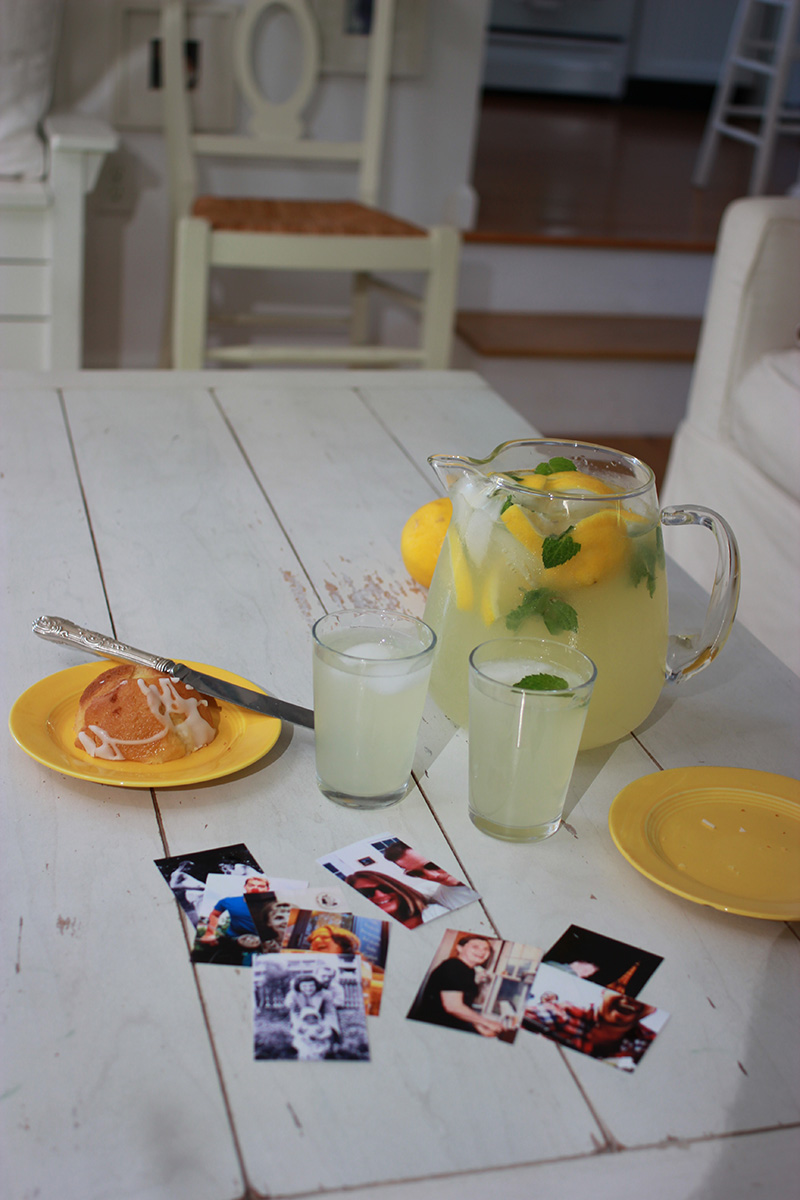
The first to be released was the e-book version, simply because it was the fastest way to get the information out there.
Next came the print version. I still remember getting the very first proof copy in my hand. I loved the feel of it in my hand, the heft, the smell. And I grinned broadly, knowing that the potential sphere of influence had just widened.

Even at that time, I knew I eventually wanted to get the book into audio format. I had heard from too many people who truly wanted to read the book and knew it would be helpful that reading was hard for them due to dyslexia, attention issues, blindness, time constraints and more.
And I’ve also been keenly aware that, sometimes, those who’ve needed what’s in this book the most have been in places where reading wasn’t going to be able to cut through the darkness.
They needed something more. They needed the human element, the compassionate voice.
Of course, there are also many, many people who just prefer to use travel, commute or leisure time to enjoy audiobooks between reading print or digital books (or during, as a means of finding brain space for several books at a time).
Some of the nicest reviews I’ve received are from people expressing that their experience with The Best Advice So Far was less like “reading a book” and more like having a conversation over lunch with a friend.
Well, all of this came to a head one day this past spring. I reconfigured my studio and sat down to record the very first words of The Best Advice So Far.
I could never have imagined on that day what a journey it would be. There were times when I was ecstatic about progress. There were others when a heaving sigh gave way to tears, realizing that hours upon hours of work had been erased for good due to program malfunctions. I’d listen through a finished chapter … only to be followed by the stomach drop as I realized that the voice tone was incredibly far off from the preceding one; and that meant re-recording chapters I loved for the sake of continuity and the good of the whole project.
Then, of course, there were the days and days of wearing headphones until my ears chafed, listening over and over to my own voice while staring at green-on-black sound waves, suppressing throat clicks and breaths, wet ‘S’s and poppy ‘P’s.
One of the most special moments in the process came toward the end, when my best friend, Dib, came to record her Foreword. We couldn’t look at one another, or we’d never have made it through. As it was, she had to start over a few times, choked up.
It reminded me once again of why I wrote the book. This is real. This is true. This can make a difference in the lives of people.
Well, I’m thrilled to announce:
THE AUDIOBOOK IS LIVE.
It was accepted upon first submission by Audible. I even got a kind personal note from the support team, saying that they rarely get submissions of such quality and without error from the get-go.
The audiobook is now available through Audible, on Amazon and iTunes. And, if you’re not yet an Audible subscriber, you can actually get The Best Advice So Far FREE by signing up and making this book your first purchase. (They even kick me a new-user “bounty,” although you’ll have paid nothing for the book. Crazy!).
And, of course, you don’t need to subscribe to Audible in order to download and enjoy The Best Advice So Far (though, honestly, if you listen to even one audiobook a month, it makes much more sense to join Audible; the first month is free, and the monthly subscription is less than the price of an audiobook).
All versions are conveniently accessible together on Amazon HERE.
And you can listen to the opening preview right there on the page.
Thank you to everyone who has continued to offer encouragement along the way. You are constant reminders of why it all matters.
I hope you will listen, and that you too will feel like you’re sitting down for lunch with an old friend.
I hope you’ll find encouragement, new ideas and a renewed excitement about the power of choice in your life.
And I hope, if it has made a difference for you, that you’ll pass it along to someone else.
Now … *deep breath* … off to start the next book!

golden ticket

I've got a golden ticket
I've got a golden chance to make my way
And with a golden ticket, it's a golden day ...
OK, so the ticket wasn’t golden. It was orange.
And it wasn’t a free ride to the Chocolate Factory. It was a $40 ride to the poorhouse.
I drove up to Boston recently, to take part in a celebration dinner for a graduating class of opticians I’d taught as a guest lecturer back in the fall.
Driving in the city doesn’t bother me in the least. It’s the parking that gets me. I’d only ever been to the location with my best friend, Dib, who drove each time. And even with her knowledge of the area, parking had never been easy. So I’d set out two hours before the event, to give myself more than adequate time to find street parking or a nearby garage.
To my surprise, I found an open spot by a meter, not even a block from the school.
The digital message on the meter informed me that operational hours were 6:00AM to 6:00PM. It was 6:05. Kismet!
Still, ever the conscientious sort, I inquired of a passerby who said he lived in the area. “This meter says it’s only operational until 6:00. Is there any reason you can think of that I shouldn’t park here?” The man assured me that I was good to go.
However, when I returned to the car after the event, there it was: the bright orange ticket, placed under a wiper.
I was aware of my pulse rising, feeling it in my throat, just under my Adam’s apple. I unfolded the citation: Resident Parking Only. $40.
Resident Parking Only? With furrowed brow, I looked both ways along the sidewalk. Nothing to the rear. Ahead, perhaps 30 feet or so, was the metallic back of some kind of sign. I walked to it and read the other side: Metered parking 6:00AM – 6:00PM. Resident Parking Only 6:00PM – 6:00AM.
I’d done my due diligence. I’d even asked a resident. How could I have guessed that a back-to sign way up the sidewalk applied to a metered area … or that the metered parking became resident parking after a certain hour?
Here, I faced a choice.
I could give in to negativity, ruminating on the unfairness of it all until my mood soured. I could get angry, decrying the City of Boston as thieves who think nothing of deception and robbing people to make a buck. I could picture that rotten police officer smirking while glibly writing out my ticket — just like every other person in authority, getting high on their own sense of self-importance. They know that people aren’t going to appeal these things, because of the time and inconvenience of driving back into the city and spending all day in court, only to have them stick you with it anyway. And all so they can pad the tills to overpay some fat, lazy cop to stand around on construction detail eating donuts …
Isn’t this how things go if we let them?
In other words, I could play the part of the victim, the oppressed.
Or …
I could start by telling myself, “You always have a choice.”
I could choose to remain positive.
I could choose to see this as an opportunity to practice patience.
I could choose go through my worry checklist, making note of what I could do about the situation if anything, and when I could do it.
I could choose to view the unseen people involved as people and not as problems.
These choices combined into a decision to visit the website listed on the ticket. That led to learning there was an online appeal process, which surprised me, having believed that live appeals were the only option.
The appeal form only allowed 500 characters — not words — with which to explain why you felt the ticket had been given in error — a fact which certainly put my skills as a writer (and problem solver) to the test. But I finally managed it and sent it off, with the promise that I’d receive an answer within 10 business days.
Let me point out that appealing the ticket could still have been done with victim mentality, assuming that the police department only offers such appeals as a technicality, and that the whole thing was just an automated process that churns out GUILTY with an email bot. Or that any actual person would be no better, not even reading what anyone has to say, just clicking “No … no … no … no …”
Honestly, I went in picturing that a reasonable person would be on the other end, or I’d never have bothered.
Sure enough, about two weeks later, I got the email reply. A decision had been made: the ticket had been repealed.
Even at this point, choices existed. Would I feel entitled, thinking, Darned right, you appealed it, ‘cause your whole stupid ticket was a scam in the first place! (You know this to be true about human nature.)
Or …
After a little digging, I was able to find a contact email address for the appeals office. I sent them a quick email:
THU 5/18/17 3:04PM
Hello,
Today, I received a letter from your office informing me that, in response to my appeal, you have administratively dismissed my ticket. I just wanted to say thank you. I'm sure much of your day is spent ameliorating tense situations and receiving negative feedback. I felt it was in order to acknowledge appreciation as well.
Enjoy our early summer!
Erik Tyler
Within a half-hour, I received a reply from a real person — Jacquelynne — who expressed her thanks and appreciation for the email, confessing that, yes, it can get wearing with all the negative, while they seldom hear the positive.
I know what you’re thinking: Yes, well, that’s all fine and dandy. But what if they hadn’t decided to repeal the ticket? Then what would you have done?
And the truth is that then … I’d have had yet more choices to make.
Appeal in person, claiming that 500 characters hadn’t been enough to adequately state my case? I could have. Likely, I would have returned to my worry checklist, paired with my go-to stress question: “Will this matter in a year?” And I would have quickly come to the conclusion (rightly so) that, no, it won’t matter in a year, and so it’s not worth another moment’s thought or happiness.
We seem to think that the course of life is determined by the big decisions we make. And I suppose to some degree, that’s true. But how can we expect to handle weightier decisions well, if we’ve made a habit of giving in to negativity and self-indulgence with regard to the hundreds of choices that came before?
The little choices we make each day have a cumulative and exponential effect. Positivity becomes easier with practice. Unfortunately, so does negativity.
For better or worse, the past is the past. We can learn from it, but we can’t change it.
The future, however, begins with one choice — the next one.



reverse

We’ve all seen those bumper stickers:
HOW’S MY DRIVING?
555-123-4567
Ever called the number to report that the driver is, in fact, currently driving respectfully and obeying all traffic laws?
After all, the sticker doesn’t say, “Call if I’m driving unsafely or otherwise annoying you.” Yet isn’t that how we tend to read it?
(Yes, I really do think about these things.)
“I want to speak to a manager.”
“Let me talk to your supervisor.”
“I’m going to email your teacher.”
In my experience, these statements are rarely followed by …
“… to let them know what a great job you (or they) are doing.”
It seems to me that perhaps many of us have become naturals when it comes to complaining, while becoming more and more uncomfortable with giving praise where praise is due.
In my last post, where I wrote about crying during a late workout, I mentioned incidentally that there was only one other person in the gym at the time: the overnight employee on duty.
Well, his name is Joe. Let me tell you a bit about him.
If you’ve ever worked the night shift, then you know … it’s no picnic. It takes an exponential toll on you. Yet Joe always smiles and says hello when I walk in. It’s genuine. You can just tell.
In talking with Joe here and there, I’ve learned that he’s an interesting guy with a lot of life behind him, despite his young age. He served in the military. He’s seen more of the world than most. Yet here he is, working a low-wage job without complaint.
And by “working,” I don’t mean simply doing his time and collecting his paycheck. Every time I drive in, I see Joe from a distance before he sees me:
Outside squeegeeing windows.
Inside toting a vacuum pack that makes him look like Dan Aykroyd in Ghostbusters.
Just emerging around the corner from the bathrooms, donning blue surgical gloves (best not to ask).
Keep in mind that this is all going down between 1:00 and 3:00 AM. There’s no manager on shift. Often, there’s not another soul around. Yet there’s Joe, hard at work when he could easily be spinning circles in a desk chair, staring at the ceiling.
No supervisor to keep him on his toes.
But that also means there is no supervisor to notice what an exceptional job Joe is doing, night after night — no one to give him an attaboy, even if only every once in a while.
I think many of us would have no problem picking up the phone and calling to speak to someone if we felt Joe was inattentive or dishonest, or if we felt he’d been rude. But who’s calling to applaud the jobs-well-done by the Joe’s of the world?
I am, that’s who.
And because griping is the norm, I’ve taken to calling this practice “reverse complaining.”
It’s a lot of fun. I highly recommend giving it a try.
*****
Here’s how reverse complaining might look at, say, a local coffee shop where an employee has greeted me with a smile and genuine enthusiasm, then prepared my order quickly and correctly:
Me: Is there a manager I could speak with?
Employee [terrified and tentative]: Yes … was there a problem?
Me: Nope. That’s why I need the manager.
Manager [looking serious and apologetic before I’ve even started]: Hello, sir. I’m the manager. Was there a problem with your order?
[NOTE: The wide eyes, bitten lips, tight jaws or held breath of employees and supervisors alike is further confirmation that complaints abound while compliments are a rarity.]
Me: No, no problem at all. I actually wanted to speak to you to reverse complain about Laura.
Manager [looks confused].
Me: I’ve noticed that Laura has greeted every single customer, including me, with a big smile and warm welcome. There have been some complicated orders, yet she’s somehow gotten them all made quickly and correctly. It’s people like her that make me want to come here rather than going to some other coffee shop.
At this point, the employee will typically beam, blush or gasp, while the manager will have trouble finding the next words.
Manager [after a few beats]: Yes, I agree. Laura is great! We love her. [Pause] Sorry for the delayed reaction there, it’s just so infrequently that anyone calls me over to say something positive.
Warm (and well-deserved) fuzzies ensue.

Back to Joe.
The night before last, as I was leaving the gym, I asked Joe who his manager was and if that manager had a card. Joe, like most, looked worried. I quickly assured him that I wanted the information in order to reverse complain about him. He grabbed a card off a nearby desk and passed it along to me.
There was no email address.
As fate would have it, I had previously contacted the owner of the gym for a different reason. So I looked up our last exchange and, using the format of her email address, created six versions using the manager’s name — one of which I hoped would work.
Then I sat down and wrote an email, reverse complaining at length about Joe.
Within a minute or two of sending, I got the dreaded “MAILER DAEMON” reply — six of them, in fact — tipping me off that Joe’s manager, Danny, must not have had a corporate email address after all.
OK, so reverse complaining isn’t always easy.
I then Forwarded the email to the gym owner, whose email address I was sure of, asking her to get the message to the location manager, Danny.
I’m not sure what will come of it. At least I know the gym owner will know who Joe is and that he’s doing a bang-up job. I’d like to think Joe’s manager will also get the message and share the positive feedback with Joe.
Just to be sure, I also called Joe over last night to tell him all the positive things I’d noticed about him.
If I’m not mistaken, there were more of those warm fuzzies on the scene.
*****
There’s an old saying:
“You’ll catch more flies with honey than with vinegar.”
I’m not quite sure about the fly analogy, but it doesn’t seem to be new news that praise works better than punishment toward fostering authentically positive behavior.
Think about it. Which motivates you more: acknowledgement of a job well done … or continual criticism?
What’s more, while reverse complaining certainly stands to encourage others, there’s also something in it for you. (And I don’t mean that others will think you’re a paragon of positivity, which is actually a precarious reason to do much of anything).
What I mean is that being intentional about building habits like reverse complaining helps us keep our own focus positive. Without a doubt, there are instances where speaking up is necessary. However, most complaining tends to be a symptom of a me-problem — essentially a declaration that I didn’t get what I wanted, precisely when and how I wanted it.
Reverse complaining, on the other hand, causing us to be more adept at noticing what is right with the world, with people and with our lives — instead of what’s wrong with them.
If you ask me, that’s a win-win practice worth pursuing.

digging out

Last Saturday, we were told to expect the first “real snow” of the winter season here in New England. Meteorologists predicted 4 – 8 inches. Though not exactly fun, we’ve had worse. Much worse. As the sky turned slate gray and the first flakes began to fall, I settled in to finish writing last week’s post, read a bit … and, of course, nap.
I had plenty of food to get me through until the next day when I’d head out and re-up my stores. In fact, I thought, I might even be able to manage a late-night workout, once this thing fizzles out.
Well, about midnight, I did venture down to brush off the car and head out to the gym.
Only the door didn’t open.
Moonlight shone blue across the surface of deep, deep snow. (We were later to find that the official reading was 16 inches.)
Crap.
Still, determined, I tromped back up the stairs, got out of my workout clothes, slid some old jeans on over sweatpants and donned a hoodie under my overcoat. Then I headed out to show that snow who was boss.
Things had wound down to little more than brittle flurries. That was thanks to the fact that, as my phone alerted me, it was now 2°F — too cold for much new snow to form.
I grabbed the shovel and became aware as I looked around that the drifts on the porch weren’t the worst of it by a long shot. I cleared the porch but couldn’t tell where the platform I was standing on ended and where the steps began. As I shuffled toward the invisible edge, I had that feeling of wading out too far into the ocean and taking that first step that drops into the abyss.
I plunged downward and was suddenly knee-deep in the stuff. It was abundantly clear that I’d be going nowhere tonight.
I slogged toward the car. As the frigid wind howled, I assessed. There’d be no place to shovel the snow other than into the hedgerow. Just too deep to throw it anywhere else.
I’ll be honest: the “hearty New Englander” in me began to crack. We were barraged the winter before last with a freak series of unrelenting blizzards that lasted months and dumped a total of over 11 feet of snow, and I felt the edges of PTSD tapping on the frosted glass of my resolve. Despite the gloves I wore, pain was already shooting through freezing fingers. And no amount of sniffling was now enough to stem the flow of snot from my nose.
It was not only deep, it was heavy. The snow brush bowed as I ran it across the hood of the car, sending vibrations up my arm (my hand itself being numb) that I knew meant beneath the smothering snow, the car was also encased in ice. Then that first swipe was interrupted as the Lincoln ornament snapped off and catapulted somewhere into the bushes, lost (sorry, Mom).
I’m not sure if I started crying at that point, since my eyes were already stinging and watering furiously.
*****
Whether an unexpected situational disaster or something more heavy and pervasive in our lives, it can be hard digging out of the places our minds can take us, and finding our way back to a place of peace and happiness.
But right there, half-buried in the snow, I began to implement my own strategies. And for some reason, it occurred to me that, though I myself think these things often and even include many of them in my book, The Best Advice So Far, I don’t write about them on my blog as often as might be helpful to readers.
So today, I’d like to share with you four totally doable strategies that really work if you’re serious about digging out of a funk:
1. Remember: “You always have a choice.”
This one is at the heart of my book, this blog, every discussion I facilitate, every talk I give. Really, it’s at the heart of everything. If you don’t settle within yourself that you are an agent of choice, then you won’t seek to change anything. You’ll hold onto victim mentality and negativity, accepting the (faulty) notion that you are stuck. Frowned upon by the Universe. Doomed to be miserable.
Sure, the amount of snow came as an unpleasant surprise. But the fact is that there was no need for me to be out at midnight trying to deal with it. There was no emergency. At any time during the goings-on, I could have headed back inside to the warmth, made myself some peppermint tea, taken a hot shower or chosen any number of other leisurely options. In fact, I have complete freedom to move permanently to a warmer region anytime I choose. There’s no one to say I can’t. And no matter how bad things could ever get in any circumstance, it is I alone who have control over choosing my attitude.
Because I’ve practiced consistently for a good while now, I’m getting fairly good at stopping myself early on whenever I start to mentally grumble, reframing the situation by saying, You always have a choice. Misery is a choice. If you allow yourself to become miserable right now, you’re choosing it; it’s not happening to you.
This small habit sets me to looking through my positivity toolbox for the best approach. (Some of my favorites are included below.)
[For more on the power of choice in reframing life, click HERE to read Chapters 1 and 2 of The Best Advice So Far, absolutely FREE.]
2. Start from where you are, not from where you wish you were.
This was one of three pieces of advice found in the book and which were instilled in me by my friend Carlotta, who has since passed away. And it’s among those I find myself quoting most often (aloud and in my own head). Wishing things were different is a notorious time waster. It keeps us frozen in a tundra of guilt, regret, depression and overall negativity. It accomplishes nothing that moves us out of our current predicament or mental mess. Dwelling on where we wish we were instead of where we are is a trap: it causes us to focus on the choices we don’t have rather than ones we do.
Using my blizzard experience as an example, no amount of wishing was going to move an ounce of snow, nor would it bring the warmth of spring any sooner. Wishing I could get out of the driveway and hit the gym would not get me there. Wishing my hood ornament hadn’t snapped off wouldn’t somehow put it back on. Starting were I am meant making choices about what I could control.
I could choose to head inside and grab some wads of toilet paper to stuff up my nostrils for the rest of the job. (Some of you may think I'm kidding; but those of you who have endured Northern winters know I'm not.)
I could choose to leave it until morning.
I could choose to set small goals for myself, rewarding myself along the way with a few minutes in the hallway to warm my hands and take the chill out of my bones before continuing. In fact, that is what I did choose. And in moving forward, bit by bit, win by win, I got the job done.
[Read Chapter 4 of The Best Advice So Far for lots more on this advice.]
3. Find the silver linings.
There’s this part of us that believes, for some strange reason, that if a piece of advice has been around a while, it’s probably not as good anymore. But some things become part of the body of enduring wisdom because they’re based in truth. And that means they don’t just change like clothing fads or hairstyles.
“Find the silver lining” is one such time-tested axiom — just as effective today as the first time it was spoken.
If you’re out of practice, a good place to start is gratitude. And I find that gratitude is best expressed in terms of what you do have rather than what others don’t. So while it’s a start to think, “There are lots of people who would love to be physically able to walk down stairs or shovel snow,” you’ll get even more benefit out of phrasing that realization this way: “I’m grateful that I have the physical ability and strength to walk up and down stairs and shovel heavy snow if I choose to.”
Here are some others:
“Good thing I still have plenty of food upstairs to last until I can get to a store.”
“A nice hot shower is going to feel even better after this.”
“The broken hood ornament is a good opportunity for me to check how much I really care about material things.”
“How fortunate I am to even have a car that needs shoveling out. This car gives me a lot of freedom.”
Again, focus on the things you can do, the freedom you have, the choices you can make. The more you practice, the easier it will become to see silver linings everywhere, regardless of circumstances.
[For more on finding silver linings and practicing positivity, click HERE to read Chapter 3 of The Best Advice So Far, FREE.]
4. Ask yourself, “Will this matter in a year?”
I can’t say for sure, but this might be the best mental question I ever ask myself. It makes things instantly very simple. And, more important — it really works.
Here’s the gist of the thinking behind this one.
When something unpleasant, irritating or unexpected drops into my lap, I ask myself, “Will this matter in a year? Will I still care about it?” Now, if the answer is an honest yes — and there are certainly times it will be — then you need a different set of strategies (I offer many in The Best Advice So Far). But in the vast majority of situations, the honest answer will be “No, it won’t matter in a year.”
And if I assess that I won’t care about whatever it is in a year (or even a week, or tomorrow, or five minutes after it’s over), then conversely, it must be true that sometime between right now and a year from now … I get over it. And if I know that I am, in fact, going to get over it at some time in the future … that time might as well be right now. After all, why pour more energy and negativity into something I know is going to vanish?
I know — seems too simple. But work out the logic of it for yourself and then give it a whirl. I’ve found that the best strategies for maintaining positivity are the simplest ones.
This is a different take on the tried-and-true "This too shall pass." And, in fact … it did. Every bit of that snow is long gone, and we're in the middle of a stretch of sunny 50° days. So I'll add a bonus tip: when you're in the middle of the funk, remember all the times before now that you've gotten through.
[Read my previous post entitled “in a year” for more on this strategy.]
*****
This list is by no means exhaustive. And there are plenty more tools included in my book and throughout five years of blog posts here. But tuck today's strategies in your pocket for whenever you find yourself faced with the temptation to spiral into destructive thinking.
They're simple. They're effective. And they'll help you follow through on your choice to be a more peaceful and positive person.

fallen: remembered
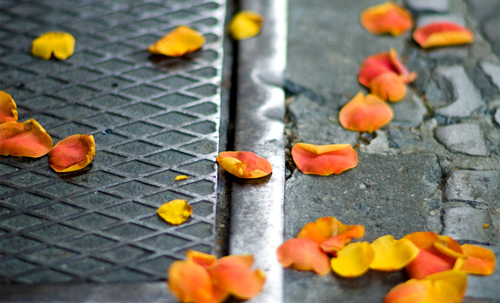
Note: September 11, 2015
Typically, I publish a brand new post each Friday. I enjoy the challenge, honesty and real-time engagement of writing new posts each week and sharing them with you. However, I felt this week warranted a first for me. While I certainly find occasions to share previous posts again, I've never reblogged the same post twice. But after having reread this post from exactly four years ago today, I was moved deeply again – in familiar ways, but also in new ones. It allowed me to refocus, to see with crystal clarity some things that had become a bit blurry around the edges. I felt there was no additional sentiment or perspective I could add at this moment that would better capture what I felt and wrote those four years past; and so it is that I share it with you again today.
We remember.

not fair

I’ve been taking a trip down memory lane lately where this blog is concerned. I love when I re-read a post from years back and have forgotten that I’d even written it, allowing me to read it in a whole new light. I love it even more when I laugh or cringe at all the right parts, wondering what’s going to happen in the story (which is saying something, seeing that I’ve lived all of these stories).
One of my earliest posts, which subsequently developed into three early and integral parts of my book, The Best Advice So Far, came from Carlotta, my friend (and my dear friends’ mom) who passed away many years ago. She left three key pieces of advice that have been mainstays in my own life, and which I’ve passed along countless times since. This post will mean all the more if you take a moment to read that earlier post first (it was one of my shorter posts), because understanding who Carlotta was will add even more depth to the wisdom she passed on.
Here is one of Carlotta’s pieces of advice, as she penned it:

And this is how the advice appears in The Best Advice So Far:


sweet somethings

It's somewhat alarming to me how many social kindnesses are rapidly going the way of the dodo. But the effect of a simple and sincere compliment is still as profound as ever. If you've gotten out of practice, getting ready to give a compliment may very well make the back of your neck go all tingly. Take that as an indicator of the positive power in what you are about to do. (And isn't it wonderful how alive that *zing* makes you feel?)
Maybe you're a leader who is committed to honing your skills as far as praising and encouraging those around you on a regular basis.
Maybe you want to know how to compliment a girl or guy you like. (Note: If you’re looking for self-serving pick-up lines, I’m afraid you'll need to visit a different kind of blog.)
Perhaps you’ve been really wanting to show your appreciation for a family member, but it feels foreign and a little weird.
Or maybe you just aren’t sure how to compliment anyone at all in a way that will be well received.
Well, this one’s for you. Here are some guidelines for how to compliment others with class and maximum effectiveness:

go team

Rogers had Hammerstein.
Han Solo had Chewbacca.
Cookies have milk.
And I have … you.
The “Thanks and Acknowledgements” section of my book, The Best Advice So Far, ends with this:
“My sincere thanks, as well, to every person so far who has read or listened or pondered or asked a question or checked in on things along the way. You are as much a part of this book as I hope it might become of you.”
I know authors sometimes say things like this that might come off as ingratiating, cliché or saccharine. Only, in my case … I really mean it, both with regard to the book and this blog.
I write. But my writing is not an end in itself. My aim is to inspire others to live like it matters, to challenge themselves to take more positive social risks, to notice and foster the best in people rather than the worst – and to remember, above all, that we always have a choice. I trust that, in small but consistent ways, that is happening as you read and experiment with me along the way.