

fake: part two

The week before last, I shared with you a post containing a bit of uncharacteristic rambling about fake things I like as well as a few I don’t personally care for. The central premise was that just because something is fake … doesn’t necessarily mean it’s bad.
Thing is, as I got toward the end of that post, some deeper thoughts began to tickle the fringe of my sleep-deprived mind. But they would have taken the post in a completely different direction (if I could have even managed to grab hold of them in that state). So I just decided to write a follow-up post.
Well, here we are. And so I shall.
In the comments section after that previous installment, there was quite a bit of interesting discussion about “fake people.” We all know them:
The too-loud laugher, or the guy with the glistening perma-smile that never quite creases the eyes.
The party guest who enters with fanfare, kisses the air beside both cheeks with an ostentatious *muah!* and always seems to be standing in camera-ready poses.
The co-worker who profusely issues compliments and nods heartily in agreement during conversations — and yet somehow always seems to be at the center of office gossip, drama and controversy.
Today, I’d like to offer some thoughts on fake people (and, quite possibly, ourselves). Let me be clear up front that my goal here will primarily be understanding and perspective, not necessarily solutions, though some of the latter may work themselves in.
the makings of fake

manipulation
I’ve made the claim often on this blog and in the book that virtually everything we do in life is done for a perceived gain. That gain is not always achieved, mind you, but our motivations remain in place.
Some of the nicest, kindest people you’ll ever meet are heroin addicts. They’ve mastered the art of penitent looks and crocodile tears. They give award-winning performances when they tell you that you’re the only person left who cares about them or explain the legitimate-sounding reason they need that loan from you.
Flirtation and insincere or surface compliments might be dished in hopes of scoring a rowdy romp, knowing before the first smile is flashed or eyebrow is lifted that it’s just for tonight.
The slickest apologies are often delivered by those who simply want you to stop talking about their faults, with never the slightest intention of actually changing.
Behaving in an outward manner that appears to be at odds with our inner self can be an effective way of getting what we want from people.
But don’t suck your teeth or point your finger at “those people” quite yet. If we’re honest with ourselves, we’ve all been guilty of me-centered insincerity at some point or other:
We've been more solicitous of a famous or influential person than we’d have been to the average Joe, in hopes that it may open doors for us down the line.
We've led into a conversation with a friend by telling them how wonderful they are, all the while knowing that it’s funneling down to asking them for a favor.
We've feigned sick or claimed to be busy with imaginary tasks, in order to get out of an awkward or tedious situation.
I’m not implying that we remain passive with manipulative people or let them off the hook. I’m simply suggesting that we strive to minimize disdain wherever possible, remembering the times we ourselves have given in to the temptation to use our acting skills for self gain.
attention
I know quite a number of people who, it seems, would shrivel up and cease to exist if they weren’t able to keep a mainline of attention flowing in.
This is the too-loud laugher at the party.
It’s the big spender — with the pile of credit card bills in the secret box at home.
It’s the limelight-stealer who always seems to have coincidentally just done something just a little more amazing than whoever spoke last.
It’s also that co-worker I mentioned earlier, or that one friend in the group, who’s everyone’s confidante — and the first to gossip in corners. Fanning flames and watching the sparks jump and catch in new locations is a fascination. Seeming to run to put them out as well feels heroic. All that’s important is remaining at the center of the action.
I’ve had countless opportunities to get past the surface with “fake” people of this variety. It often takes a long time and lots of patience, because the need for attention is every bit as much an addiction as drugs or alcohol. And withdrawal or detox are just as painful. Normal levels of attention feel the same as being invisible. And feeling invisible … feels like being dead.
Often, if you go back far enough, this brand of “fake” stems from feeling unloved. And along the way, attention in its many forms became the substitute: the close-enough. Ironically, while these people may occasionally get a short-lived fix, their approach usually leads to even more rejection and loneliness.
safety
For some, smiling, nodding in agreement and laughing at every joke feels safe. Social niceties, personal inquiries, stories and winks can come off as feeling rehearsed … because they are.
Unlike attention-fake, the safety-faker is generally well-liked. They're popular even — just not well-known.
Large groups actually feel safer to these people, because they can blend in and use their safety go-tos often without being discovered. They are the best party hosts — and yet the most insecure people.
These “fakers” don’t have malicious or deceptive intent. In fact, if you take the time to get to know them, you might be surprised to find that they’ll confess they are “terrible with people” or uncomfortable with conversation. Once their rehearsed stand-bys run out, they begin to feel stuck, even panicked, and will often withdraw.
Safety-fake can also be a substitute for love: "I know how to be what I think people want me to be. But I fear people wouldn't like the me that I really am inside."
This would also include the people pleasers (my former self included). People like happy, fun, entertaining people. So we learn to be happy and fun and entertaining — even when we’re crumbling inside.
etiquette
Many people I know were simply raised to smile and laugh warmly, despite how they might be feeling about a person or situation. Think of the classic Southern Belle (though this type of rearing is certainly not limited to any particular region).
And really, the problem isn’t with practiced cordiality itself. In fact, most of us put this into play at some time or other.
You’re at that gathering where you’ve been cornered by someone who’s been talking for the last half hour without pause about the different types of eyes used in puppet fabrication. (Yes, this really happened to me.) You’re starting to sweat and feel a tightness in your throat, panicking that you’ll still be standing there in another hour. Or two. Will anyone rescue you?
But what do you do? You raise your eyebrows, smile and say, “Uh-huh” or “Mmmm…” with much nodding of head — even after the words have turned to the horn sounds the adults made in the Peanuts cartoons.
What's the alternative if you can't get a word in edgewise? Run away in the middle and later claim that you had to throw up? Shout over them (at your friend's party, mind you) and tell them outright that you frankly don’t give a rip about whatever they’ve been talking about?
Sometimes, you just have to grin and bear it, reminding yourself that the present squirmy feeling won't matter in a year. (Though when I know the corner-trap guest is at a party, I always plan my escape with certain friends who stay on the lookout, ever ready for that rescue.)
Acting in contrast to how we may feel based on etiquette is different from doing so for reasons of safety. The former is based on “good breeding” (whether the instruction itself was balanced or not) and may be employed by confident people as a point of strength, whereas the latter is typically a coping strategy for dealing with insecurity.
sincerity
A couple of years ago, a change in health plans landed me with a new primary care doctor. Upon my very first visit, I found the usual questions taking a turn down an odd path. Do you smoke? and Any allergies? drifted into questions about family history of depression, spending habits and the like. Keep in mind that this was within five minutes of meeting me for the first time.
I stopped him mid-question and stated directly, “It seems to me that you’re attempting to diagnose me with mental illness, bipolar disorder if I had to guess.”
He stopped writing and bit his lip. Guilty.
“Well, if you want to know, yes. You do seem a bit too … happy.”
There have been times when I’ve invited someone to a gathering with my close circle of friends, and they’ve confided in me afterward, “They all seem great. But it felt … weird. Nobody is really that nice, for that long.”
And we aren't the only ones. I've known many wonderful people across a lifetime who've been labeled by some as "fake," but who I knew to simply and legitimately be that nice.
That excited.
That gregarious.
That happy to see their friends.
That interested in what others had to say.
Even if it’s perhaps not the norm or quite what you may be accustomed to.
*****
Just as with the first post on the topic, let me point out that perhaps what you see as “fake” may be more complex — less black-and-white — than you’ve been seeing it.
I might even go so far as to say that there are no fake people. There are only real people making real choices for specific reasons.
This also seems the perfect opportunity to reiterate one of the central pieces of advice from the book:
Focus on the person, not the problem.

Again, my goal here isn’t to suggest how to “fix” anyone. My hope is that in considering the why over the what, you may find ways to trade judgment for empathy a little more often.
And in the process, you may even gain some insight into your own choices where being fake is concerned, toward making different choices tomorrow.




hear! hear! (the story behind the audiobook)

I still remember the first time as a mentor that I had to turn someone away.
Until then, no matter how many others I was committed to at the time — no matter how strongly I debated with myself that I couldn’t stretch any further — I found a way for “just one more.” But then there it was: the first I’m sorry, I won’t be able to.
As someone who believes in the difference one person can make in the life of another, and who is deeply empathetic, it was like a punch to the gut.
About the same time, years of “kids” I’d mentored, past and present, along with their families, secretly organized an appreciation dinner in my honor. I have to say, not only was I shocked, the timing was uncanny.
As part of the evening’s events, I was given a seat in the middle of the crowd. I remember meeting eyes around the room, one by one. For more than an hour, people spoke word of affirmation or thanks, expressing what I had meant to their lives. Tears welled up (just as they are even now, as I recall the day). Even being a writer, it’s be hard to put to words what that was like.

One young man, Alex, said something that night that has not only stuck with me, but which has changed the course of things thereafter. Alex said, “You’ve mentored so many of us, but somehow, when we’re each with you, you make us feel like we are the only one.”
Wow. Just wow.
Those words reminded me why I’d had to turn that first person away. Yet at the same time, they made me wish I could find a way to always have room for “just one more.”
Soon after the event came graduations.
I write a lot of cards at graduation time, as one might imagine. And they are always personal. I take my time on each one, thinking about what that person might need to hear or remember at this exciting and yet daunting time of transition from childhood to adulthood.
While I was writing a card to my own cousin, Dylan, a light turned on. What if I were to collect the best of what people have expressed has helped them and write it all down?
It suddenly seemed the next natural progression. I would always be limited in the number of people I could invest in one on one; but through writing, I could reach many, many more people whom I’d never be able to speak with in person.
The very next day, I started this blog and began writing my first book, The Best Advice So Far.
Before the book was even complete, I began being asked to speak.
Parents of kids I mentored wondered if I’d speak to larger parent groups.
Parents within those groups pointed out that the things I spoke and wrote about applied not only to young people or parents, but to … well, everyone. Young and old. Individuals and businesses. Married or single. Because the power of choice — of continually choosing positivity over negativity — is universal. And so I began to speak more often as I continued to write.
Right from the beginning, with the photo shoot that would become the cover, things were personal, brimming with love and support. My friend Michael was the photographer, and the location was right in the living room of my best friend, Dib, down by the ocean. I used her pitcher and glasses and plates, and mint clipped from her garden. Even the photos I chose to include within the cover image are each snapshots of real people I love, real stories we've lived — real moments that have changed my life.
[Below is one of the unedited shots from that shoot, which became what is now the various covers of The Best Advice So Far.]
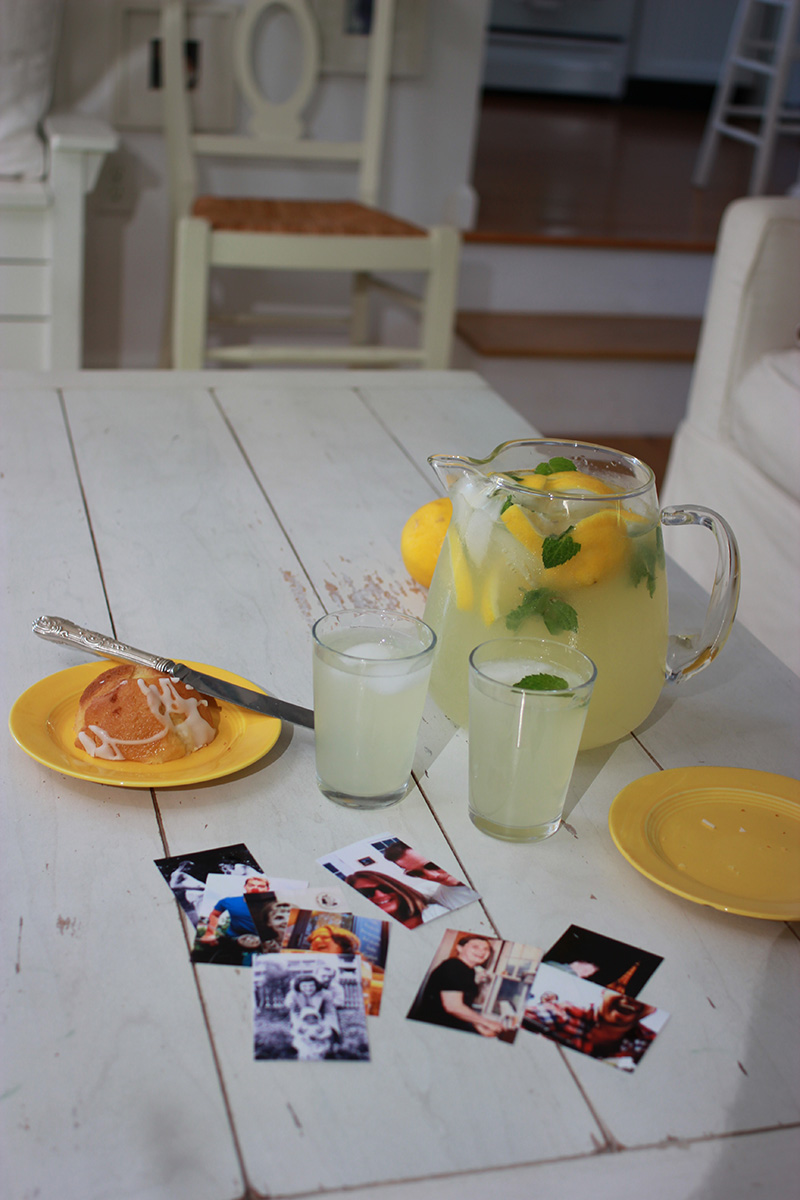
The first to be released was the e-book version, simply because it was the fastest way to get the information out there.
Next came the print version. I still remember getting the very first proof copy in my hand. I loved the feel of it in my hand, the heft, the smell. And I grinned broadly, knowing that the potential sphere of influence had just widened.

Even at that time, I knew I eventually wanted to get the book into audio format. I had heard from too many people who truly wanted to read the book and knew it would be helpful that reading was hard for them due to dyslexia, attention issues, blindness, time constraints and more.
And I’ve also been keenly aware that, sometimes, those who’ve needed what’s in this book the most have been in places where reading wasn’t going to be able to cut through the darkness.
They needed something more. They needed the human element, the compassionate voice.
Of course, there are also many, many people who just prefer to use travel, commute or leisure time to enjoy audiobooks between reading print or digital books (or during, as a means of finding brain space for several books at a time).
Some of the nicest reviews I’ve received are from people expressing that their experience with The Best Advice So Far was less like “reading a book” and more like having a conversation over lunch with a friend.
Well, all of this came to a head one day this past spring. I reconfigured my studio and sat down to record the very first words of The Best Advice So Far.
I could never have imagined on that day what a journey it would be. There were times when I was ecstatic about progress. There were others when a heaving sigh gave way to tears, realizing that hours upon hours of work had been erased for good due to program malfunctions. I’d listen through a finished chapter … only to be followed by the stomach drop as I realized that the voice tone was incredibly far off from the preceding one; and that meant re-recording chapters I loved for the sake of continuity and the good of the whole project.
Then, of course, there were the days and days of wearing headphones until my ears chafed, listening over and over to my own voice while staring at green-on-black sound waves, suppressing throat clicks and breaths, wet ‘S’s and poppy ‘P’s.
One of the most special moments in the process came toward the end, when my best friend, Dib, came to record her Foreword. We couldn’t look at one another, or we’d never have made it through. As it was, she had to start over a few times, choked up.
It reminded me once again of why I wrote the book. This is real. This is true. This can make a difference in the lives of people.
Well, I’m thrilled to announce:
THE AUDIOBOOK IS LIVE.
It was accepted upon first submission by Audible. I even got a kind personal note from the support team, saying that they rarely get submissions of such quality and without error from the get-go.
The audiobook is now available through Audible, on Amazon and iTunes. And, if you’re not yet an Audible subscriber, you can actually get The Best Advice So Far FREE by signing up and making this book your first purchase. (They even kick me a new-user “bounty,” although you’ll have paid nothing for the book. Crazy!).
And, of course, you don’t need to subscribe to Audible in order to download and enjoy The Best Advice So Far (though, honestly, if you listen to even one audiobook a month, it makes much more sense to join Audible; the first month is free, and the monthly subscription is less than the price of an audiobook).
All versions are conveniently accessible together on Amazon HERE.
And you can listen to the opening preview right there on the page.
Thank you to everyone who has continued to offer encouragement along the way. You are constant reminders of why it all matters.
I hope you will listen, and that you too will feel like you’re sitting down for lunch with an old friend.
I hope you’ll find encouragement, new ideas and a renewed excitement about the power of choice in your life.
And I hope, if it has made a difference for you, that you’ll pass it along to someone else.
Now … *deep breath* … off to start the next book!
umbrella

Singin’ in the Rain just may be my favorite movie of all time.
I watch the film at least once a year, and I reference lines or scenes from it often. It still gives me the same feeling it did the very first time I saw it. I laugh just as hard. My eyes still get wide at some of the dance numbers. And, of course, I sing along through the whole thing.
I dare you to watch it and not at least smile.
In Gene Kelly’s big number, his character, Don Lockwood, is feeling giddy with new love; and so, despite the torrential rain, he waves his driver on and walks home, using his umbrella as a dance prop rather than as any sort of protection. Soaked and smiling broadly as the scene ends, he hands his umbrella off to a shrug-shouldered and miserable-looking man passing the other direction.
Between gorgeous sunny streaks, we’ve also had our share of heavy rain here in Florida, where I’m spending the month of August. In fact, within my first 24 hours here, I was caught driving in the most blinding storm I can recall — the sky, road and crushing downpour all blending into one continuous sheet of gray.
And I hadn’t brought an umbrella.
Thing is, I could easily have bought one. But — call me crazy — I just figured, why bother? So I get a little wet. I’m getting wet in the ocean and pools and hot tubs anyway, right?
During one such storm, I ventured out to get a few things at the nearby grocery store. I hadn’t quite stopped dripping by the time I got in line at the register. Yet there in front of me, right in the store, an even bigger storm was brewing, lashing out at everyone nearby.
Being quite late at night, there were only two check-out lanes open: a standard lane and a 10-items-or-less lane. I was in the latter. A family of four was currently being rung and occupied the short space between the cashier and the bagging station.
The middle-aged woman between that family and me was in full rage, shouting loudly, throwing her hands this way and that to further emphasize her tirade:
“Yeah, I know you saw the g*#d@* sign! Don’t pretend that you don’t speak #$%&* English either! Yeah, you speak English plenty fine when you want something, don’t you. 10 ITEMS OR LESS! What, you need @$&*% help counting to 10? Lemme help you! ONE … TWO … THREE …
She jabbed a rigid finger at remaining items on the belt with each count.
The screaming woman continued:
“… NINE … TEN! That’s right! Not 12! Not 15! Not @#$&* whatever you want! You @#$&* IMMIGRANTS come over here thinking you can do whatever the @#&% you want, while the people who LIVE HERE are supposed to just sit back and take it! Go back to wherever you came from! Maybe they’ll teach you how to COUNT!”
The family stood there red-faced. The children looked visibly shaken, cowering away from the outburst and pressing half-faces into their parents.
The belligerent woman didn’t let up. Next, she lit into the mortified cashier, a woman of about 70:
“You should’ve told them to go to the end of the other line! It’s people like you who let these @#$&*% people walk all over us! Any other store, you’d be fired for no following the rules and making them leave! I’ve been standing here all night with my five items — yeah, that’s right,” she turned to the family again, “five! Not @#$%& FIFTY! G$*d#* IMMIGRANTS!”
Now, in my estimation, the family had approximately 20 items. And “standing here all night” was approximately two minutes.
Throughout this, I was not more than three feet behind this woman, watching all of this. Many things crossed my mind. I wondered if I should intervene, say something, defend the family or the cashier. I was embarrassed at the behavior of someone who was treating others this way in the name of “America.” I wanted to somehow let the attacked family know that this woman didn’t represent most people. But something told me that engaging with her would only have prolonged the episode for all involved.
The cashier, Joan, kept her attention squarely on the family, somehow managing to ignore the invective that was underway. In what was surely her best effort to make the family feel welcomed and safe, she smiled encouragingly and apologetically at them, moving their remaining items through as quickly as possible. Payment complete, she bid them “Have a nice day” as they grabbed their few bags and made a bee-line for the door without looking back.
Joan took a slow, deep breath, then began to ring the items of the irate customer. With her best attempt at cheer, asked the woman, “Did you find everything you needed today?”
The woman was still proclaiming her outrage, “You should’ve made them move. It’s not fair that you make everyone else wait …”
Joan spoke in a light tone, “I understand how frustrating that must be. We don’t always see into the cart to know exactly how many items someone has until after we’ve begun ringing. I’ll be sure to keep an extra careful eye out next time.”
Despite Joan’s choice to exercise humility and even bear the burden of fault (instead of immediately having called for management or security, which would have been the reasonable choice), the angry woman continued to murmur her complaints until her order was completed and she stormed out.
Though the entire ordeal had lasted only minutes, Joan looked pale and harried. The storm had taken its toll. Still, she gave me the brightest smile she could manage. “How are you tonight, sir?”
I put my hand on the conveyor belt to stop its movement. I caught Joan’s eyes and smiled. I don’t believe I could have turned the tide with the previous woman’s diatribe. But this was a moment I could make the choice to do something about.
“Joan, that was an awful situation. I’m sorry you got caught in the middle of that. I can’t believe how well you handled it, focusing your attention on that family and making them feel like valued customers, and then treating that angry person with respect and dignity as well. Not many people could have held up with grace if faced with the same thing. Good job.”
Joan’s small smile broadened and her eyes moistened in true appreciation (and, I hope, pride).
I took my hand off the conveyor and she began scanning my few items.
Blip. Blip. Blip.
“I’d also like to speak to your manager," I added, "to let them know how impressed I am with you, Joan.”
Joan looked around as if she were being filmed by news crews and cameras were flashing her way. She clearly was not accustomed to compliments.
The attendant at the nearby customer-service desk, who’d been watching the whole thing, spoke up: “I’ll call a manager right now for you.”
Joan finished ringing my items and, as I paid, thanked me profusely for my kindness. Meanwhile, the manager had arrived. I stepped out of the lane so Joan could ring the next customer, but spoke loudly enough so that she could hear me. I told the manager about the incident and how extraordinarily Joan had dealt with all involved.
A smile crept across the manager’s face and he spoke even more loudly than I had. “Great job, Joan! I’m buying you lunch tomorrow!” Then to me but just as loudly, “Joan is one of my very best employees.”
A small round of applause broke out, led by another cashier but including all nearby workers and even customers.
Joan blushed, grinning broadly.
On my way out, I caught her eye one more time and smiled affectionately.
As the exit doors slid open, I felt just as I imagine Gene Kelly had giving away his umbrella — then singing and dancing out into the rain.


what not to say

I always seem to have some crazy story or other to tell, don’t I?
I was asked a thoughtful question recently, as my birthday nears: “What would you like to see more of and less of in the year ahead. After The Zinc Fiasco of 2015/2016 and last month’s visit to Death’s door (aka, The Black Pill Debacle of 2017), my “less-of” response seemed a given”
I’d like to have less … in the way of health issues.
Don’t get me wrong. I consider myself very fortunate. Yet when birthday presents past include a medical dictionary marked with sticky strips on every page containing some strange malady I’ve encountered … one might have reason to suspect that something’s up.
And many have told me I’m the healthiest sick person they’ve met so far. (I suppose that’s true to my nature, being a lifelong “balance of extremes” as I call it.)
Well, wouldn’t you know, a week ago today (just after I finished writing last week’s post, in fact), I wound up adding another sticky to that medical dictionary of mine.
The hedge along the driveway had turned into a jungle; and the worker the landlord had hired to take care of it had just informed her that he’d have to postpone — until the second week of September. Well, that was just not an option. The drive would literally be impassable by then. So the landlord asked if I might consider taking care of tedious job for some cash. I agreed.
Picture it if you will:
- Eight-foot overgrown hedge
- Five-foot ladder on an uneven gravel drive
- Electric hedge trimmer
So there I was, tip-toeing on the second-to-last rung of the too-short ladder, stretching as far as I could over the top of the hedge to get those last few outcropping branches at the far side … when the ladder began to wobble.
I reached out instinctively to steady myself … on nothing … and in doing so, let go of the heavy, two-hand-operated saw …
… which dropped immediately to continue buzzing on into my left hand.
It’s hard to describe what you wind up thinking in a moment like that. One thing is for sure: you just know it’s bad.
I tossed the saw in the other direction and jumped (or, rather, fell and happened to land on my feet) as the ladder toppled.
Before I could manage to clutch the injury in a tight grip with my good hand, I got enough of a glimpse to see the gore. Blood bubbled up through the fingers that closed around it, dripping to the ground.
I couldn’t feel anything at first, of course. A small mercy at least. But my brain didn’t need to feel anything in order to imagine the worst.
Was it one finger or two? Were they still attached or was I just holding the pieces together?
I ran inside and knocked as hard as one can with an elbow on the landlord’s door.
No answer.
I was going to have to deal with this myself.
[Sinking feeling in pit of stomach.]
Now, I’m famously calm, cool and collected when it comes to dealing with other people’s injuries. But when it comes to my own … I just can’t manage the emotional distance necessary.
I got upstairs and ran the kitchen sink. The time had come. I’d have to look.
Quickly, I plunged my hand under the gushing stream of water, which turned pink as it gurgled and swirled its way down the drain. Part of my left index finger flapped up and down as the flow rushed over it.
Well, it was just one finger.
And it didn’t fall off in the sink.
This was good.
The pain was setting in now and, while the blood continued to pulse out, I was still able to assess that it was a deep, jagged cut. Between fluttering flesh and blood, I could see white or yellow.
This was not good.
I must’ve kept my finger under the water a full five minutes, squirting dish soap over everything often and trying to remember everything I’d learned in life thus far about serious wound care.
Make sure it’s clean.
Keep pressure on it.
It was probably time for that pressure. I grabbed a wad of paper towels and squeezed it around my finger with a vice grip using my other hand. I could feel it throbbing. Soon the paper towels were red. I changed them.
Keep it elevated above heart level.
Put ice on it.
I did these things.
Avoid infection at all cost.
I remembered something about salt. I filled a large bowl with water, more dish soap and copious amounts of salt, then sank my hand — bloody wrappings and all — into the bowl.
The Best Advice So Far: Don’t add copious amounts of salt to an open wound if it can at all be avoided.
It was a long afternoon and night.
Eight hours later, however, after doing everything right as far as I could figure, it was still bleeding pretty badly.
*sigh*
I hopped in the car, continuing to keep my mummified hand held high, and drove myself to the ER.
*****
Stick with me here. I promise — I’m not delirious from pain meds. There is a connection between my story and where I’m going with things next.
*****
Recently, I caught some episodes of the Netflix original series Luke Cage. It takes place in Harlem and centers on a main character who has found himself with unusual strength and impenetrable skin after being the subject of a prison experiment. I think it’s fair to say that 95% of the characters in the series are either black or Hispanic.
I found it a hugely entertaining show. Yet I do believe I heard the “N-word” more often by the end of the first episode than I’d heard in total during my lifetime to that point.
Thing is, while I’m sure many might debate this on several levels … it sort of fit. It wouldn’t have seemed as real if the writers and directors had had the street kids and kingpins of Harlem referring to one another as “African-Americans,” or calling their inner circle “Buddy” or “Pal.”
I’ve worked closely as a mentor with inner-city kids. Close friends in the black community really do call one another — even themselves — the “N word.” But take my advice: I wouldn’t try it if you’re white, no matter how much you may like someone.
I have gay friends who quite affectionately call one another … well, terms that I wouldn’t recommend you use if you’re a straight co-worker.
And while your spouse may look in the mirror, sigh in exasperation and say, “I’m getting chunky,” please — don’t take this as permission for you to sigh in exasperation and say, “Yes, you certainly are getting chunky.”
Debate it all you like. There are just some things that a person can say about himself or herself that others simply can’t (at least not without heaping woe upon your own head).
*****
There I was in the ER. During the many phases of check-in and registration, or as I chatted with others in the waiting room, I stayed as positive as I could for someone who still didn’t know the extent of my injury. I bolstered myself both mentally and aloud to others with such things as “I’m lucky. It could’ve been worse.”
But four hours later, when the receiving nurse finally called me in, I found myself a little put off when she greeted me with a joke (“At least it wasn’t your middle finger; you need that one”) followed by a statement of exactly what I’d been saying myself so many times to that point:
Well, it could’ve been worse.
You see, when I say it about myself, it’s encouragement and positivity.
But when someone else says it to me … it has the opposite effect. It invalidates my pain, my fear, my concern.
Other seemingly ubiquitous exclamations that I’d include in this category of “I-can-but-you-can’t”:
I know exactly how you feel. Why, when this happened to me …
I once knew a guy who [had something more horrific happen to him].
(About a break-up or divorce) Well, now that they’re gone, I can tell you that I never really liked him/her anyway.
The problem with each of these is that they minimize what the other person is feeling or experiencing.
So what do you say instead? Try:
Oh no … you poor thing.
I’m so sorry this happened to you.
I’m right here if you need me for anything.
This isn’t coddling. It’s not commiserating. It’s called empathy. And we’d each do well to know the difference.
In fact, genuine empathy doesn’t require words at all.
It’s looking someone in the eye with compassion.
It’s a shared grimace or a shoulder squeeze.
It’s letting silence be silence if need be.

*****
I was fortunate enough to have gotten a doctor who specialized in wound surgery. He commended me on how clean I’d managed to keep it. And he shook his head, mystified, that the cut was as deep and covered as much area as it did, and yet hadn’t disrupted any of the major “stuff” in such a tight space: bone, joint, tendon (all of which he could also see), artery, major nerves.
Given the location and jagged nature of the wound, he decided that going in with stitches might cause more problems than it solved. He used some powders and ointments that temporarily stopped the bleeding and applied liquid stitches (which I still think is just plain old SuperGlue), compression wrapped it, splinted it, and told me not to unwrap it, move it or get it wet for four days — unless, of course, the bleeding resumed.
I’m happy to say, while I’ll have nasty scar, the healing process is going remarkably well. Any loss of sensation is slight, and I have nearly full motion back.
I consider myself highly fortunate.
It could’ve been worse. Much, much worse.
But if you care about me, don’t be the one to tell me so.
*****
A few additional thoughts in closing:
I do believe that there’s a nebulous amount of time that passes after hard things, after which we might be able to agree with someone aloud about how lucky they are or how “it could have been worse” without being too insensitive. If you’re not sure how much time that is, don’t chance it and err on the side of caution.
I also think there are a select few people who, for them to say such things to one another even at the start, is almost the same as saying it yourself. This includes only the very closest of friends and family; if you’re not sure whether or not you hold that place with someone — you most likely don’t.
A rule of thumb I try to live by is this: only if I myself would feel completely loved, supported and validated were a specific other person to say such things to me, should I assume it’s OK for me to say such things to them.

superstition

It was Thursday, well past the witching hour. I was on my way to the gym, the silent back roads lit only by the cold white light of an occasional street lamp. As I approached an intersection, something darker than the surrounding night dashed out from the woods in front of my car, stopping just long enough to fix bright green eyes on me before continuing into the thick brush on the other side.
A black cat.
And it had crossed my path.
Of course, being a rational person, this didn’t cause me to turn back the way I’d come and find an alternate route. Yet I was clearly still aware of the superstition associated with the incident. And it occurred to me that this awareness did have a subtle effect on my emotions. I drove onward as I normally would have; but some part of me felt I was doing so despite the superstition. And that would seem to indicate that the superstition had credence, if only in a residual way.
In other words, it seems to me that we don’t do things despite other things, unless those other things are perceived to hold some power or sway.
We wouldn’t say, “We had the picnic despite the forecast” — unless we perceived that the forecast had at least the potential to disrupt our plans.
Back to the example of the black cat crossing our path, it’s almost as if some small part of us feels we’ve accepted a dare, and that by crossing that path, we’re somehow giving the proverbial finger to the universe, proving we’re not one to be controlled by such nonsense.
No one could deny that we don’t have the same reaction when, say, a squirrel or turkey crosses our path. It wouldn’t even occur to us to think such a thing. Why? Because, well … we really don’t believe squirrels or turkeys crossing our path makes a lick of difference.
I guess what I’m saying is that all of us are affected to some degree — maybe even more than we might be aware — by voices from our past.
Culture. Society. Family. Religion. Media.
And no matter how reasonable we might be, we never entirely shake those influences.
Another example: in the last two weeks, I’m fairly certain I’ve heard at least three grown adults whom I consider to be intelligent, rational people relay to me with grim acceptance, “Well, you know what they say … bad things happen in threes.”
Even I myself, in that same stretch of time, had my wallet stolen and bank card charged up. Last night, on my way to see a movie, I got yet another call from the fraud department of a card that has never left my possession, telling me that someone in Florida had racked up nearly $1000 on the card, and had even gone so far as to access my account and change my address, mother’s maiden name and other details. And just before I sat down to start writing this post, my check-engine light came on for the first time since I’ve owned this car.
One.
Two.
Three.
Now, if pressed on the issue, most of us wouldn't voice support for the idea that a superstition like “bad things happen in threes” is rational. Who or what would be in charge of managing such a “rule”? And why?
And yet, if we’re honest, here again, we have to admit that a teeny tiny part of our emotional self has heard the words so many times that we wind up “shrugging off” such things: which can only mean that we’d felt they had climbed on, somehow, in the first place.
So where am I going with all of this discussion on superstition?
Well, it also occurred to me that black cats and other bad luck aren’t the only “collective voices” we’re in the continual process of needing to “shrug off.”
I was talking with a young man earlier this week. During our discussion, he made claims about himself that included such things:
- “I’m terrible with details.”
- “I forget everything.”
- “I guess I'm just dumb.”
And at different points, after listening to him talk, I’d challenge him:
- “You just told me that you read and compare medical reports on natural remedies and supplements. So are you really terrible with details?”
- “You don’t forget to come to work. Ever. And you’re good at your job, even though you haven’t been there long. So do you really forget everything?”
- “Every time I see you, you’re reading a new philosophy book or telling me your thoughts on comparative religion. Dumb people don’t do that. So why do you say you are ‘dumb’?”
In each instance, he’d pause and then backpedal a bit. But only in a qualifying sense: “Well, I don’t forget that” or “Well, I’m not dumb in that area, but …”
And the deeper I dug, the more I realized that each erroneous belief was rooted in collective voices from his past, things he’d heard or believed residually for so long that they felt true and powerful to him, even in the face of logical evidence to the contrary.
In other words, it seemed to me that he had certain superstitions about himself — that he was in a constant state of imbalance, trying to scramble around darting black cats that were shadow puppets of others’ making.
Perhaps you’ve made the leap with me so far, from “silly” cultural superstitions to personal ones. You’ve been willing to accept that maybe you’ve been hard on yourself in some areas that, if you take a close look at them, are just plain malarkey.
Don’t get too comfortable just yet.
Is it possible that, whether wittingly or unwittingly, you yourself are letting loose some black cats into other people’s pathways?
Take prejudice, for example. Surely, you don't consider yourself prejudiced, do you? I'm going to suggest that there may yet be superstitions lurking within your inner self where others are concerned.
For instance, might even a seemingly reasonable self-statement such as “I’m not prejudiced against [_______]” hold similarities to continuing to drive “despite” the black cat?
Put another way, I wonder if such claims may be more akin to “I’m open-minded and evolved enough to accept other people even though they are black / Latino / gay / Muslim / poor (i.e., “not like me,” who is the assumed standard of normal).”
I accept people even though.
Despite.
I guess what I’m suggesting is that the mere acknowledgement of such categorizations is evidence that socialization has in fact accounted for some of our thinking. [Even the labels I myself chose to include identify thinking associated with a particular assumed readership.] Ergo, some of that thinking — may be flawed and thus in need of adjustment.
Small children, when they accept another child, don’t think in terms of “I like them even though …” If you were to ask them to tell you why they accept someone else, they’d respond with something like, “Um … because they’re nice” or they’d roll their shoulder and say, “I dunno” and go skipping off.
No matter how old, how educated, how enlightened any of us may consider ourselves (or may actually even be, in relative terms) we’ve all got faulty beliefs. It’s part of being human, of living in a world with other humans. We influence — and we are influenced.
It seems to me that real wisdom isn’t reaching some pinnacle of perfection, but rather being honest enough to continually assess our ideas. To never become so attached to a mindset that we can no longer admit where we might have been wrong — and to let go. To adapt. To grow.
To change.


creative love

Due to an unexpected turn of events this week (a stolen wallet, fraudulent charges to my bank card and all that goes along with getting your life back to normal afterward — a topic about which I may write in more detail at a later time), I'm still not quite over the finish line where the audiobook release of The Best Advice So Far is concerned.
In the meantime, I thought I'd share one more audio chapter — Chapter 14: “Creative Love.”
This chapter has remained one of the most popular and most talked about chapters of the book. What's more, the chapter combines memories from 4th-of-July celebrations both recent and long past. So in honor of Independence Day, Tuesday here in the U.S., I thought sharing this chapter would be apropros.
Click the link below to listen to the official audiobook recording of Chapter 14: “Creative Love” (the full chapter text is below, if you'd like to follow along):

CHAPTER 14
CREATIVE LOVE
A year has passed since I got caught in that 4th-of-July traffic jam I told you about in the chapter on choosing positivity. Last night, I joined the best people for food and fireworks by the ocean. Unlike many towns, this one has taken to allowing private citizens to light their own fireworks along the shoreline. Not sparklers and bottle rockets, mind you. Real, honest-to-goodness fireworks. And lots of them.
Of course, this is all off the books. Fire and police officials “happen” to be very busy in remote parts of town at those hours, it seems — ::wink wink:: — but let's just keep that between ourselves, shall we?
As our little clan made our way along the sidewalks, the town was out in force. Patriotic music played strong and clear as we passed one yard, then seemed to garble like the tuning of a short-wave radio as we walked, only to gradually form itself into another solid tune as we approached the next yard — all accompanied by much boisterous and bad singing. Dogs strained at leashes, barking wildly at the cacophony. Children clustered together on quilts and blankets, bedecked with glowing bracelets and necklaces and halos, all wide-eyed and slack-jawed as they beheld the wonders in the sky.
The sea wall was packed, layers deep. No one seemed to mind. But I navigated my way through the crowd and down the concrete steps, then jumped from the wall to enjoy the spectacle from the rocky beach below. The nearest firework bundles and boxes were a mere twenty feet away from where I sat. Should be exciting.
The colors and assortment were dazzling, all fired quite low and seemingly right overhead. But what struck me most was the magnitude of sound. Whizzing. Screeching. Whirring. BOOMing. It was the loudest I could recall.
Ever.
At one point, it became overpowering. The sound — not the light — was actually hurting my eyes. So I closed them for a moment, placing my hands over them and pressing firmly with my fingertips. That's when the flashback hit.
Ricky.
It was the summer I had graduated from high school. I'd gotten a job at a school for the blind, and I had three “boys” assigned to my care, all of them in for a short-term summer program. In truth, they were each older than I was.
Ricky was 18. Aside from being blind, Ricky had pronounced Asperger's Syndrome. This was also accompanied by a form of echolalia. That is, Ricky's tendency was to copy or rephrase what other people said, rather than forming responses with any real personal meaning. So, if one asked Ricky, “Are you having a good day?” he might reply “I'm having a good day” — whether he was having a particularly good day or not.
Ricky was the best. Though he was a year older than I was, he had the affect and voice of a sweet-tempered six-year-old. I was fascinated, but even more determined to have actual communication with him. I was 17 and had no real training. What did I know. But I thought it odd that staff just fell into Ricky's patterns, asking predictable and repetitive questions to which they got his predictable and repetitive responses. One day early on, I tried something.
“Hi, Ricky,” I said.
Ricky smiled, weaving his head back and forth, which I already understood meant that he was excited and happy. “Hi. Hi, Ricky. Hi,” he replied.
“Did you have a good day today?” I asked.
“I had a good day today,” Ricky said.
“And what did you like about today?” I continued.
Ricky fell silent. He stopped swaying as if he were listening for something far off. Then he continued his dance, without answering me.
I tried again. “What did you like about today, Ricky?”
He paused again for a moment, then resumed his rhythmical bobbing. “It's nice,” he said.
I welled up (much as I'm doing even now as I recall it). Ricky had given a real answer!
I continued asking only questions which Ricky could not repeat or rephrase with ease. In what seemed a very short time, Ricky and I were having meaningful exchanges regularly.
I remember the day — or rather the night — that Ricky spoke first to me, without my having asked him anything. I had just tucked him into bed and he began to cry. “I'm sad,” he said. This was very unusual for someone like Ricky, to report on how he felt, however obvious.
“Why are you sad, Ricky?” I asked.
“Mom,” he said.
“You miss your mom?” I asked, again finding this peculiar behavior, even without any real training.
“I miss my mom,” he replied, giving in to his comfort zone of repeating. But that was all right. He'd already told me as much.
Ricky sobbed for a long time that night without any more talk. I stayed with him, lightly raking his hair with my fingertips or squeezing down his arm, which he enjoyed. After more than an hour, he finally fell asleep.
This same scenario played out for the next three nights. Ricky would cry when I put him to bed, and I would stay with him and get him to sleep. After a few days of contemplation at his bedside, I had concocted a plan. There was no way to be sure whether or not it would work, except to just try it and see what happened.
The next day was my day off. I picked up a painter's cap for $5.00. I chose it because it was soft and durable, and the lid was flimsy instead of hard. The following day, I tucked the hat inside my work bag. When bedtime came, sure enough, Ricky began to be homesick. I hated to think about the night before, because I knew the other staff member would not have stayed with him or comforted him. As Ricky began to cry, I took out the hat. I placed it into his hands and helped him feel it. “What do you think this is, Ricky?”
“A shirt,” he guessed.
“Nope. It's not a shirt. Good guess. Try again,” I urged.
“Try again,” he agreed. A few moments later, he said, “Underwear,” then scrunched his face up and giggled like he'd told a naughty joke.
Weeks ago, when Ricky had first arrived, I'd helped him unpack. He had exactly two pairs of yellowed underwear in which the elastic waistbands were stretched and torn. There were two undershirts and one pair of socks, all in similar repair, along with a couple of T-shirts, a pair of jeans and one pair of shorts. This was to last the whole summer. The following day, I had immediately gone shopping and later presented Ricky with a small but new wardrobe — one item at a time. And so it seemed he did remember the day I had given him the underwear, as he guessed at what lay in his hands now. The memory of Ricky's reddened face, giggling even as the tears of homesickness streamed down, is still very clear in my mind.
I laughed, too, and replied as if he'd really gotten me with his joke. “No, Ricky, it's not underwear, silly. It's a hat.”
“It's a hat,” he said, as if he'd thought of it himself. He felt around the opening and the rim again, trying to make sense of the new revelation.
“It's not just any hat, though,” I said mysteriously. “It's a magic hat.”
He didn't reply this time, just listened. I had his attention.
“Here's how it works. You say out loud all of the things you miss and love about home, and the hat remembers them. Then, you put on the hat, and it helps you think good things about what you miss, so you won't be sad while you fall asleep. So, here we go. Let's hold the hat together in our hands and think of as many things as we can think of that you love about home. What's first?”
“Mom,” Ricky said, sniffling.
“Good one! And what else do you love about home?” I prompted.
He scrunched his eyes, which were always closed, as if considering. “Cookies.”
“Cookies? Nice! And what else?”
“Books.” (I hadn't realized before then that, of course, he might like a bedtime story. But I didn't interrupt.) Ricky had already stopped crying as he thought. Before long, his answers became mumbles that meant he was drifting off . I took the hat from his hands.
“OK, now let's put the hat on you, so you can think about all those things you love about home,” I said as I pulled the hat over his mop of brown hair. He reached up and touched it, then pulled the covers up and fell asleep. “Good night, Ricky,” I said.
The plan had worked. And it continued to work every night thereafter at bedtime.
The 4th of July fell on a Saturday that year, and most parents had come on Friday to get their children for the weekend. Ricky's parents lived in New York, and so had not come. I offered to take Ricky to fireworks that night, even though I was not on shift. This was met with much debate. Bringing a blind student with multiple needs to an event like fireworks? Too upsetting. And you're not even working. But no one could argue that Ricky trusted me and was calmer when I was on. And I had clearance to drive the vans. My taking Ricky for the night would also mean that other staff would not have to stay on duty for one student.
And so, we went.
Now, I honestly can't remember how the next turn of events came about. But my sister Shannan wound up coming along. She was sixteen at the time, and had absolutely no experience with special needs. Still, she came. I wondered how she would be with Ricky.
Ricky grew very anxious as the crowds thickened approaching the main event. Shannan and I told him that fireworks would sound very loud and scary, but that it was the fun kind of scary. “It's fun,” he said, but he didn't seem too sure. Patriotic music played somewhere close by. My sister, without hesitation, asked Ricky if he would like to dance. Ricky's whole life was a dance, in a way — rocking and bobbing and doing the two-step. And so he accepted her offer. She helped him up and fell right into his little two-step, as if it were the cool kids' dance. “You're a really good dancer, Ricky,” she said.” He laughed his giddy laugh. “I'm a good dancer!” he shouted, elated to be dancing with a real live girl.
Soon, the first “test” rockets fired, and Ricky was clearly nervous. We sat down on the grass, my sister on one side, and I on the other, pressing in tight on either side so that Ricky would feel safe. “This is going to be a lot of fun!” I assured him. “All of the sounds will be different, because the fireworks look different.”
For Ricky, there would be no bursts of color. No designs in the air. No light — only sound. Ricky tilted his face upward in expectancy, as he waited for whatever would happen next, somehow understanding that the noise had come from above him.
Then my sister said something which I'd forgotten until the memory resurfaced last night: “I'll draw pictures on your back of what it looks like.”
It was brilliant, really. And moving.
The first legitimate explosions rained overhead. Ricky gasped, but he didn't seem anxious now. I squeezed his hand and said, “Wow! This is scary! Sometimes, it's fun to be scared!” Ricky smiled, with red light shining on his upturned face. Shannan got up and knelt behind Ricky, then wiggled her fingertips over his back in an outward motion approximating what was happening in the sky. The next one screeched out five separate rockets that spiraled away at the end. Ricky squeezed my hand tighter. My sister drew arcs with curly-Qs up Ricky's back, one at a time. And so it continued.
I really believe that Ricky was having all the fun of going to a scary movie with good friends. He began to laugh out loud, or crouch smaller at the bigger booms, giggling. All the while, I squeezed his hand as my sister drew forms.
THE BEST ADVICE SO FAR: Tenacious love expressed with creativity can work wonders.
Another shattering *BOOM* brought me back to the present, where I sat there with my fingertips still pressed over my eyes. A few tears escaped as I remembered Ricky and the events of that night.
I wondered where he was, and what he might be doing today.
I wondered if he still had the magic hat.
I wondered if he remembered me, or that night when he'd danced with a girl who smelled nice.
I wondered if he might be at fireworks somewhere even tonight, smiling, squeezing his hand tighter and feeling imaginary fingertips drawing pictures across his back.
What I did not need to wonder about — what I was certain of — was that time, creative energy and love had been well spent all those years ago.

100% approval rating

I’ve been around the world. From Beijing to Bohol to my own backyard, I’ve had personal dealings with thousands upon thousands of people from all walks of life.
What’s more, I don’t just write about the power of choice. I practice it. I put it to the test with people. I’ve experimented with what works and what doesn’t where it comes to human relationships. I’ve honed my interpersonal skills. I’m known for being accepting, patient and kind. And I genuinely like people, so I’ve got that going for me as well.
Based on my travels and extensive interactions with people the world over, I’ve collected and analyzed vast amounts of data. And I now wish to share with you today — for the very first time — my complete list of surefire tips and tricks that will allow anyone to achieve …
A 100% Approval Rating
Get ready to be loved by all. At long last, here is the definitive list of ways to get absolutely everyone to like you, thereby achieving a 100% approval rating from others:
Yep, that about does it.
Shortest post yet.

[P.S. This post is in no way a political commentary on any person or thumb, past or present. In fact, it's not even about me. This post … is 100% about you.]

chance

I’ve used the word “kismet” quite a few times lately. It’s the only word that seemed to fit several series of events that have had my head spinning in the very best of ways.
Let me tell you about one of them.
If you read my last post, then you’re familiar with Joe — the hard-working overnight crew member at my gym. Well, as diligent as he is, every so often, he does still take a break. It was during one of those breaks that I saw Joe reading a book.
Being an avid reader and writer myself, I asked, “What are you into there?”
Joe stuck his thumb between the pages to hold his place and flipped the book over to show me the cover. Some peaceful golden sunset colors. Maybe a beach. I think there was a bird flying across it as well. “It’s, like, a book of life wisdom. Just short quotes,” Joe explained. “You could open the book anywhere and read it and then just think about it for a while and get something.” He handed me the book as he said this, with the clear implication that I should put this last bit to the test. My own thumb became the new bookmark and I flipped a page or two forward.
I read a two-line entry at the top of the right-hand page. I don’t remember exactly what it said. Something about Fate. It had an Eastern feel. I remember that I had agreed with the central idea. But at the moment, I was focused on Joe, curious to know more about why he had chosen to read the book. “Why this book?” I asked as I passed it back. “Is it something you’ve chosen to read? Or maybe something for a class?”
“Oh, not for a class. I’m just interested in learning more about life and philosophy, stuff that makes you think, y’know?” Joe said.
“And what do you do with the thoughts you're pondering while reading this, after you’ve read them,” I asked.
Joe paused. “Ummm, I don’t know. Just kind of think about them and try to find the truth in them.”
Hmmm, I thought.
“Joe, if you’re into this kind of book, I have a recommendation for you. I’m not meaning to be the pushy salesman type, but … I’m actually a writer and author, and my current book is based on collective wisdom. It’s about living life in a way that matters. It’s called The Best Advice So Far.” I brought the Amazon page up on my phone to show him. “Each chapter has a central thought, just like the book you’re reading. And also like that book, you can skip around if you want; you don’t have to sit and read it straight through, cover to cover. Only my book is different because it doesn’t quite fit into philosophy or self-help or inspirational. It’s a lot of true stories, some of them pretty crazy, from my own experience, and the stories sort of illustrate the advice. Then it gets into how you can actually put the advice to good use in your own life, starting immediately.”
Joe squinted at the phone screen, seeming genuinely interested. “I’ll have to check it out. That’s really cool.”
Then an idea hit me. It occurred to me that I had one spare copy somewhere in my car.
I excused myself briefly and then returned with the book, presenting it to Joe. “If you really think you’ll read it, I’m happy to give you a copy.”
I continue to be amused and surprised whenever someone looks at the book, sees my name on it, then looks back at me incredulously like I’m famous or something. “Wow, you wrote this? That’s crazy.”
As I’m fond of saying, “I live with me, so I’m not that impressed.” But I didn’t say that aloud to Joe. Instead, I just smiled and said, “Yup. Think you’ll read it?”
“Oh, definitely,” Joe assured me, still ogling the cover.
We talked a few more moments about how the cover design had changed. I showed Joe the before-and-after shots. “Oh, yeah, the new one’s a lot better. Looks more … refreshing.”
I was happy to think of the revamped cover — and the content — as “refreshing.”
I told Joe I hoped he enjoyed it, then I jumped back into my workout.
When I left, Joe had set aside his first book and was a little ways into mine. Good feeling. I sincerely hoped he’d find something life-changing in its pages. “See you next time,” I said. And that was that.
Well, the next time came. And Joe stopped me as I came in.
“So … I’m about eight chapters into your book. But then my mom stole it from me. She’s the real reader. She read it in one day.”
“Wow,” I said. “Did she like it?”
“Well, it was funny. She did like it. And she also called me over and said, ‘I think I know some of the people in this book.’”
He definitely had me curious.
He continued. “She thought she knew that kid Chad you write about a couple of times, so she texted her friend to ask her if her son was the Chad in a book called The Best Advice So Far.”
Well, as it turns out … Joe’s mom’s friend was my friend Chad’s mom.
In fact, it turns out that Joe had attended the same high school as Chad, the year ahead of him, and Joe’s younger brother, John, was in Chad’s graduating class. They were all friends, and knew many of the same people I knew. Yet I’d never met Joe before he’d started at the gym two weeks prior.
I mean, what are the chances of Joe having been reading a book that was in line with my book …
and my having happened to have a spare copy in the car …
and Joe’s mother having happened to take an interest in the book …
and her having somehow pieced together the details about Chad without a last name …
and the kid I’d handed the book to having been fairly good friends with one of my closest friends who happened to be a featured character in my book?
Like I said — kismet.
Or was it?
I called Chad to tell him about the chain of coincidences that led back to him. And while we both marveled at it, Chad said, “Funny to think that all of those connections between people existed before you ever handed Joe the book. You just might never have known about them unless you had reached out, talked to Joe, asked about his book, and been willing to give away a copy of yours. It’s cool to think about how many similar ‘coincides’ are waiting to happen all around us, all the time — stuff we’ll only ever find out if we engage with people. If you hadn’t, Joe would still just be some nameless guy at the gym.”
And, of course, I hear in that “You always have a choice.”
Years ago, I mentioned in my post “guilty pleasures” (on shedding societal mores) that one of my favorite movies is Ever After. A memorable line from the movie seems apropos here. Says a spirited Leonardo da Vinci to Prince Henry of France:
“You cannot leave everything to Fate, boy. She’s got a lot to do. Sometimes you must give her a hand.”
It does seem to me that much of what we consider chance is really the result of choice.
At least a lot of the good stuff.


reverse

We’ve all seen those bumper stickers:
HOW’S MY DRIVING?
555-123-4567
Ever called the number to report that the driver is, in fact, currently driving respectfully and obeying all traffic laws?
After all, the sticker doesn’t say, “Call if I’m driving unsafely or otherwise annoying you.” Yet isn’t that how we tend to read it?
(Yes, I really do think about these things.)
“I want to speak to a manager.”
“Let me talk to your supervisor.”
“I’m going to email your teacher.”
In my experience, these statements are rarely followed by …
“… to let them know what a great job you (or they) are doing.”
It seems to me that perhaps many of us have become naturals when it comes to complaining, while becoming more and more uncomfortable with giving praise where praise is due.
In my last post, where I wrote about crying during a late workout, I mentioned incidentally that there was only one other person in the gym at the time: the overnight employee on duty.
Well, his name is Joe. Let me tell you a bit about him.
If you’ve ever worked the night shift, then you know … it’s no picnic. It takes an exponential toll on you. Yet Joe always smiles and says hello when I walk in. It’s genuine. You can just tell.
In talking with Joe here and there, I’ve learned that he’s an interesting guy with a lot of life behind him, despite his young age. He served in the military. He’s seen more of the world than most. Yet here he is, working a low-wage job without complaint.
And by “working,” I don’t mean simply doing his time and collecting his paycheck. Every time I drive in, I see Joe from a distance before he sees me:
Outside squeegeeing windows.
Inside toting a vacuum pack that makes him look like Dan Aykroyd in Ghostbusters.
Just emerging around the corner from the bathrooms, donning blue surgical gloves (best not to ask).
Keep in mind that this is all going down between 1:00 and 3:00 AM. There’s no manager on shift. Often, there’s not another soul around. Yet there’s Joe, hard at work when he could easily be spinning circles in a desk chair, staring at the ceiling.
No supervisor to keep him on his toes.
But that also means there is no supervisor to notice what an exceptional job Joe is doing, night after night — no one to give him an attaboy, even if only every once in a while.
I think many of us would have no problem picking up the phone and calling to speak to someone if we felt Joe was inattentive or dishonest, or if we felt he’d been rude. But who’s calling to applaud the jobs-well-done by the Joe’s of the world?
I am, that’s who.
And because griping is the norm, I’ve taken to calling this practice “reverse complaining.”
It’s a lot of fun. I highly recommend giving it a try.
*****
Here’s how reverse complaining might look at, say, a local coffee shop where an employee has greeted me with a smile and genuine enthusiasm, then prepared my order quickly and correctly:
Me: Is there a manager I could speak with?
Employee [terrified and tentative]: Yes … was there a problem?
Me: Nope. That’s why I need the manager.
Manager [looking serious and apologetic before I’ve even started]: Hello, sir. I’m the manager. Was there a problem with your order?
[NOTE: The wide eyes, bitten lips, tight jaws or held breath of employees and supervisors alike is further confirmation that complaints abound while compliments are a rarity.]
Me: No, no problem at all. I actually wanted to speak to you to reverse complain about Laura.
Manager [looks confused].
Me: I’ve noticed that Laura has greeted every single customer, including me, with a big smile and warm welcome. There have been some complicated orders, yet she’s somehow gotten them all made quickly and correctly. It’s people like her that make me want to come here rather than going to some other coffee shop.
At this point, the employee will typically beam, blush or gasp, while the manager will have trouble finding the next words.
Manager [after a few beats]: Yes, I agree. Laura is great! We love her. [Pause] Sorry for the delayed reaction there, it’s just so infrequently that anyone calls me over to say something positive.
Warm (and well-deserved) fuzzies ensue.

Back to Joe.
The night before last, as I was leaving the gym, I asked Joe who his manager was and if that manager had a card. Joe, like most, looked worried. I quickly assured him that I wanted the information in order to reverse complain about him. He grabbed a card off a nearby desk and passed it along to me.
There was no email address.
As fate would have it, I had previously contacted the owner of the gym for a different reason. So I looked up our last exchange and, using the format of her email address, created six versions using the manager’s name — one of which I hoped would work.
Then I sat down and wrote an email, reverse complaining at length about Joe.
Within a minute or two of sending, I got the dreaded “MAILER DAEMON” reply — six of them, in fact — tipping me off that Joe’s manager, Danny, must not have had a corporate email address after all.
OK, so reverse complaining isn’t always easy.
I then Forwarded the email to the gym owner, whose email address I was sure of, asking her to get the message to the location manager, Danny.
I’m not sure what will come of it. At least I know the gym owner will know who Joe is and that he’s doing a bang-up job. I’d like to think Joe’s manager will also get the message and share the positive feedback with Joe.
Just to be sure, I also called Joe over last night to tell him all the positive things I’d noticed about him.
If I’m not mistaken, there were more of those warm fuzzies on the scene.
*****
There’s an old saying:
“You’ll catch more flies with honey than with vinegar.”
I’m not quite sure about the fly analogy, but it doesn’t seem to be new news that praise works better than punishment toward fostering authentically positive behavior.
Think about it. Which motivates you more: acknowledgement of a job well done … or continual criticism?
What’s more, while reverse complaining certainly stands to encourage others, there’s also something in it for you. (And I don’t mean that others will think you’re a paragon of positivity, which is actually a precarious reason to do much of anything).
What I mean is that being intentional about building habits like reverse complaining helps us keep our own focus positive. Without a doubt, there are instances where speaking up is necessary. However, most complaining tends to be a symptom of a me-problem — essentially a declaration that I didn’t get what I wanted, precisely when and how I wanted it.
Reverse complaining, on the other hand, causing us to be more adept at noticing what is right with the world, with people and with our lives — instead of what’s wrong with them.
If you ask me, that’s a win-win practice worth pursuing.

the good old days

Ah, the good old days.
The simpler ways of bygone eras have become an indelible part of our collective consciousness, stirring a sense of wistfulness at their passing, whether we actually lived through them or not.
Neighbors leaned from open windows or across picket fences to chat, and thought nothing of asking to borrow an egg or a cup of sugar. Newcomers were welcomed with a jingle of the doorbell and a proffered platter of freshly made cookies or a Bundt cake. And it was assumed that all were invited to the backyard barbecue.
During trips to the local grocer or druggist, owners and customers greeted each other by name, never in too much of a hurry to ask about the children or that recent vacation. And partings were peppered with give-my-best-tos.
Young people helped the elderly across busy intersections, offered to carry their bag a few blocks, and climbed trees to rescue their kittens.
Sinewy men slung a tattooed arm around their buddy’s neck as they crowded together around diner booths — some sitting, some standing with one foot propped on the edge of a seat — swapping outrageous and animated stories with other guys from town.
People took leisurely strolls down shady streets, played chess in the park, had picnics on Saturdays and impromptu dance parties on the beach. No one dreamed of whizzing by a kid’s lemonade stand without stopping.
Friends threw dress-up dinner parties, and guests offered small gifts upon arrival, as well as following up with a thank-you card by mail a few days later. Just as likely might be a game night during which participants played Twister, eventually collapsing into a heap upon one another and laughing until their cheeks hurt.
Wholesome stories and images abound, combining to weave a sort of glorious fairy tale — one continuous happily-ever-after.
Of course, we tend to overlook the historical backdrops that fostered a sense of connection and interdependence: the Great Depression, two World Wars, the beginning of the Cold War era. And story lines played out on tube model televisions, between commercials for Pepsodent and Py-o-My, were unlikely to depict the less idyllic realities of those decades.
But be that as it may, I have to ask: Why must all things good, simple or wholesome be circumscribed to the realm of nostalgia? Why can’t the present be just as good … as ‘the good old days’?
Do windows no longer open through which to call out a hello to the neighbor as she works in the garden?
Do families moving in next door no longer enjoy baked goods or a friendly welcome?
Midway through writing this, I took a stroll uptown along shady streets. There were no newfangled signs forbidding me to do so.
I greeted people walking the opposite direction. They smiled and greeted me back.
As I entered the corner store and coffee shop in the center, I observed lines of anonymous people ordering. Checking out. Eye contact was fleeting at best. Names were not asked, offered or used. Clerks asks in rehearsed tones, “Will there be anything else?” to which they received various mumbled versions of “no” as patrons scrolled through cell phones.
When I approached the counter, I greeted Trish and then Brett by name. Eyebrows and cheeks immediately lifted, straight-line mouths forming into smiles as each in turn hailed me by name, asking how I’d been. At slower times, it’s not infrequent for workers to step out from behind the counter for a hug, as well. I joked and made good-natured conversation with the others waiting in line for coffee and donuts — an older woman, a father with a small boy riding his shoulders — each of whom smiled back and engaged all too happily.
What was it that transformed this otherwise mundane scene into something out of an episode of The Andy Griffith Show?
Had I stumbled upon some sort of temporal vortex back to ‘the good old days’?
Nope.
In fact, for the most part, living in a modern Mayberry is possible for anyone, of any age, at any time, and regardless of where you live.
Those of you who know me or have read much of my writing at all know exactly what’s coming next, don’t you?
That’s right. It all comes down to that magical little thing … called choice.
You see, there’s nothing about when you happen to have been born or where you happen to live that determines your ability to be welcoming or inviting to those around you each day.
Whether you can take a walk, plan a picnic lunch, or dance on the beach.
Whether you can speak to the cashier by name and offer your own, write a thank-you card, or help someone in need.
You needn’t be able to make aspic in order to have friends over for dinner.
And they even still make Twister.
Silent Generation to Gen Z.
Mayberry to Metropolis.
Scooter to subway.
None of it has a lick to do with whether or not you can smile or say hello.
The life we live and the world we live it in are largely products of our own creation, constructions built choice by choice over time.
So grab yourself a root beer float, wave to your neighbor — and decide what you want your ‘good old days’ to look like, starting today.
